 Editorial
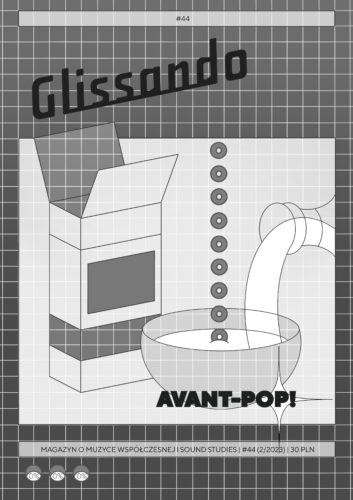
Transitional Forms: Pop and the Avant-Garde in the Work of Transgender Musicians
I
As I was getting ready to write this text, I had a dream: I’m sitting on a park bench and suddenly Dua Lipa comes and sits down next to me. I greet her as if it was no big deal and tell her I’m going to write for the next issue of Glissando. Excited, I tell her about my idea and ask what she thinks of it, and she answers, “Bullshit, tell everybody that avant-pop doesn’t exist.” And then she adds something like, “It’s just about having fun.”
This won’t be an article about Dua Lipa, but it will be about women in music – more specifically, transgender women and non-binary artists. Nor will it be a rebellion against the theme of this issue – I’m happy to defend the vibrant presence of avant-pop, or more broadly, the connections between the avant-garde and popular music. It’s in the space between them that opportunities for free expression by transgender people often arise – the chance to express themselves, their own identities, and the experiences tied to them. I see avant-pop, ephemeral hyperpop, noise pop, and all musical hybrids at the intersection of pop and experimental music as spaces full of creative freedom, where genre norms are transcended, definitions are eluded, tropes are blended, and vocals are played with (evolving and transcending gender divisions). Dua Lipa is absolutely right about the fun aspect, but I’ll come back to that later.
It took several decades before the world of pop music began to open up to transgender people, even though the music industry had long drawn inspiration from their work. The prime example of this inspiration – and at the same time, the exception that proves the rule when it comes to the industry’s openness – was disco, which gained global popularity in the 1970s. To the glistening beat of the four-to-the-floor and within the community that formed around the genre, queer people – including transgender individuals – could feel safe and dance in the arms of whomever they wanted. And then there was the wonderful Wendy Carlos – a virtuoso of electronic music, co-creator of the first synthesizer, and champion of the instrument, without which the sound of disco would be unimaginable. Fifty years ago, Carlos was the first artist to speak publicly about her transition – and this was a time of archaic terminology, restrictive diagnostic criteria, and social invisibility for people who didn’t fit into the gender binary.
Looking for signs of change, one could jump forward to 1998 and the 43rd edition of the Eurovision Song Contest, won by Dana International, a transgender singer from Israel. Was it a turning point? As Marcin Bogucki writes in his essay “Queerowanie Eurowizji. Szesnaście lat po wyoutowaniu (Queering Eurovision: Sixteen Years After Coming Out)” (2014)1, the contest had clearly been moving away from heteronormative ideology for years, expanding the representation of non-heteronormative and transgender people in the musical mainstream. At the same time, Bogucki rightly notes that queer themes present in the television show are most often portrayed in a selective, homonormative manner, and that the inclusive stance of some countries remains part of a marketing strategy.
And what about identity diversity in popular music today? The industry is still dominated by cisgender men, and you can still sometimes sense a dismissive belief that the work of transgender people is mainly intended for a queer audience. At the same time, more and more trans women are noticeably blazing trails in new microgenres, being invited to collaborate with world-renowned artists, and earning nominations for major (though it depends on who you ask) awards. Trans artists are emerging from the periphery and entering the mainstream – progress is slow but visible. The experimental electronic music scene and the underground club scene (with a “no racism, no sexism, no homophobia, no transphobia” policy) have always been much more inclusive, though there is no shortage of examples of discriminatory behavior (even within the LGBTQIA+ community itself). In the independent scene, there are plenty of examples of record labels and festival lineups that are diverse in terms of gender and racial identity and include different minorities. Unfortunately, in many circles the attitude that translates proclaimed values into real action is still lacking. However, overall, regardless of genre, decade, or perspective, music tends to blur divisions rather than reinforce them, and in this regard, it is ahead of other branches of culture, including even cinema.
In this text, I’ll focus primarily on the means of expression, techniques, and forms of expression that are present in both the mainstream and independent scenes – and which, through their mutual interaction, transport us to a place full of sincerity and intimacy. A space where neither trans artists nor non-binary individuals – nor we as listeners – are faced with a choice: song or instrumental improvisation, opera or a small, smoky club, tradition or futurism, a low (presumed masculine) or high (presumed feminine) voice. The scope of this intertextuality and genre collage in the work of transartists is broad and will certainly only continue to expand. The selection of musical projects in this text is therefore dictated by my personal fascination with specific examples, but it also aims to present the phenomenon as comprehensively as possible. I will therefore discuss various tools, diverse ways of using the voice, performing, and deconstructing or weaving melodies by trans and non-binary artists of various backgrounds, active on different stages in different parts of the world.
II
These are the words of British producer Lara Rix-Martin, speaking about the label she founded in 2016. Alongside albums by Jana Rush, Jtamul, and Ziúr, Objects Limited has also released two albums by RUI HO (pronouns: she/her)3 – a Chinese artist who blends folklore with modern club music and has been making waves as a DJ on the domestic and European scenes for several years.
Becoming is an Eventful Situation, recorded in 2018 after moving from Paris to Berlin, is her calmest, most narrative album. The EP Pursuit of the Sun, released a year later, shakes you out of your static stance and pulls you onto the dance floor to join in the fun, maintaining a high-energy pace from start to finish. Recorded during the second year of RUI HO’s transition, it reflects her ever increasing confidence and openness in sharing passion with others. The next step forward in her musical career was also a step backward on the map – after several years abroad, RUI HO returned to Shanghai, where she reconnected with her roots and sought to engage with her home audience.
Shortly after moving, in September 2020, she released Lov3 & L1ght, this time on the Planet Mu label, founded by Rix-Martin’s husband, Mike Paradinas, known as µ-Ziq. Presented in a much more accessible, lyrical style and featuring her own vocals, the album has been a bold step beyond the boundaries – or perhaps the limitations – of independent music, manifesting the expression of an artist through hyperpop songs. It managed to combine synthetic melodies, with some predictably structured, self-referential lyrics, with complex, unconventional, daring structures.
“I wanted to make something simple for everyone, but there’s always something highly complex going on in the background,” says HO in an interview with Kasia Jaroch for PW-Magazine.4 The transition hasn’t heightened the register of her voice and on the record we hear her vocals processed with autotune, the most commonly used effect in similar situations. Although many people still thoroughly hate autotune, it works great within the digital, futuristic environment of Lov3 & L1ght. However, RUI HO’s vocal training – and above all, her journey toward self-acceptance – have brought about a certain change: “I hope to learn to love my own voice and be able to find ways to express myself with the voice that I have, without having to fear it.”5
RUI HO’s approach is quite similar to the one developed by Lyra Pramuk (currently performing as Alif Hilal). “I want to feel like a wild animal when I’m writing music and singing. (...) To think that we’re different from the rest of nature is the biggest gag of the last 500 years or longer in Western civilization – we are nature. ”6 These words, spoken by the artist (pronouns: she/her7) in an interview with Pitchfork, remind us of where her roots lie.
Pramuk grew up in Pennsylvania, in a small town surrounded by forests and farms, where she spent many years singing in a church choir and participating in theater groups. She continued her studies at the Eastman School of Music in Rochester. Rigorous training paved the way for her conscious, multilingual vocal improvisation, though still within a strongly gendered framework. After moving to Berlin in 2013, Pramuk began working on her debut album, Fountain, and exploring her identity more deeply and freely. As a non-binary transfeminine person, after several years of attempting to achieve a hyper-feminine sound, she began to recognize the value of utilizing the full range of her voice, treated as a non-binary instrument.
It is precisely thanks to this difficult shift in perspective that we are presented with the forty-minute, meandering symphony that is Fountain. The album is closest to contemporary experimental music, though when listening to tracks like Tendril or Gossip, I’m struck by their folk-pop energy. The element that bridges these melodic, folk-inspired pieces with more ambient forms is precisely the transformative, malleable vocals. It allows the music to transcend gender stereotypes and expectations, while enabling listeners to trace the history and identity of trans artists – as Marta Konieczna and Karolina Kobielusz note in their article “Zabieranie głosu” (2020). 8
The evolution of vocal artistry can also be traced in the queer-infused work of Michelle Olczak (she/her), a producer associated with Warsaw’s young independent scene. I had the opportunity to hear her DJ set on the final day of the Wrocław edition of the Avant Art Festival in 2021. Sonically rich tracks from her first album zgubiłem się – remixed and performed with addition of added live saxophone – drew me in and captured my attention, rousing me from fatigue of a lengthy festival.
Upon finding her on Facebook, I realize she’s been performing under a new alias, Spineless Actress. I check out the debut album as Spineless Actress, Before Shape, released on the Warsaw-based label Neurøpasza. I’m genuinely surprised by its relatively accessible style – club-ready dynamics and sung, repetitive phrases.Yet at a certain point, the catchy melody glitches and burns out from the sheer amount of distortion, the tones take on an unhealthy, neon hue, and the vocals undergo minor, futuristic surgery. I return to zgubiłem się. Here the vocals are very sparse – in two of the seven songs, you can hear hazy vocalizations and staccato recitation; the rest are instrumentals. I interpret Before Shape as the next stage in the exploration of one’s own identity, in which the voice plays a particularly important role. Clean vocals, followed moments later by various effects – (though not excessively used) reveal the relationship with the voice during the process of formation or rediscovery. The title of the EP seems clear, and Neurøpasza’s description confirms these assumptions: “Positioning themself in opposition to shapeless forms of alienation, gender normativity and social structures, they go through a process of creating a shape, a body that can define itself without definition.”9
The aforementioned essay, “Zabieranie głosu” (2020), begins with a paragraph about the Venezuelan producer Arca (Alejandra Ghersi, she/her, it/its), who must be mentioned here as well. The authors write about how she balances between extremely different tones – falsetto and deep bass, a childlike timbre and operatic singing – transcending the limitations of the human voice and established musical genres. Let’s take a closer look at the five-volume KiCk collection released at the turn of 2020 and 2021. The dynamics of her vocals and the radical freedom behind the sonic diversity of the individual albums – as well as within them – demonstrate that Arca isn’t interested in following a specific stylistic path, but rather in pursuing a course of consistent change. It is therefore difficult to speak of attracting a pre-existing “targeted” audience from any particular musical scene – rather, the artist continues to explore new territories. The only apparent conceptual thread is the transhumanist album art across the entire series, which aptly captures the artist’s transformative nature. KiCk i, the first album released after Ghersi’s coming out as a non-binary trans woman, opens with the manifesto track Nonbinary. Behind the powerful, provocative lyrics, a barrage of heavy electronic beats and their sharp shards builds up, but the closer it gets to the finale, the smoother the timbre becomes, sounding almost cynical. The song ends on an ultra-cliché note, which to me is like throwing a joker on the table – and it’s impossible not to smile at that moment (though it might be a goofy, sheepish grin of getting roasted). With this intro, Arca makes it clear that she’s the one calling the shots here, and every move – whether toward abstract innovation or commercialism – will happen strictly on her terms. After Nonbinary, we’re treated to, among other things: (a) KLK – a reggaeton banger (a genre that has moved from Puerto Rican clubs into the mainstream of pop for good) featuring Rosalía, (b) a beautiful, classically sung love song (Calor), and (c) a shift toward bass-heavy, broken sounds, led by an exceptionally intense track recorded with SOPHIE (La Chíqui). On subsequent KiCk releases, Arca has continued to celebrate her multiplicity, setting her albums predominantly either within club-oriented or ambient stylistics. As she says in an interview with The New York Times:“It’s to actually create a bridge for those that have different aesthetic sensibilities or different backgrounds to meet in a shared space that pop can provide.”10 She then adds: “I do see a lot of possibility for the creation of a self that isn’t a photograph, that can change over time. I think the Latinx community is that. It’s going to be shape-shifting ever after and forever, hopefully in the same way that queerness is.”
Since we’ve already reached the subject of two cyberdivas working together, I’ll move on seamlessly to SOPHIE. The producer’s musical career – brief, as it was tragically cut short by death at the age of thirty-four– had a massive impact on the revitalization and development of contemporary avant-garde pop, while also shaping the hybrid microgenre that became known as hyperpop. Starting in 2013, the Scottish artist released a series of bass-heavy, glistening singles that later appeared on the compilation album, PRODUCT. Its content sometimes delivers the instant gratification promised by its eye-catching packaging, whereas at other times it makes you wince with its metallic aftertaste as it becomes truly hard to swallow. The ultra-high, digitally processed vocals, however, remain consistently sweet. “Shake, shake, shake it up and make it fizz/ Make it pop and sizzle,” we hear in VYZEE, which encourages us to try something that – with its multitude of sensations – might make us feel better. The even more effervescent LEMONADE was used in a 2015 McDonald’s commercial promoting, of course, lemonade. The use of LEMONADE was surprising – these days global corporations typically use songs by popular artists in their marketing campaigns, and at that time SOPHIE was still part of the musical underground. The PC Music label, with which the artist collaborated closely, employed similar strategies as the artist and operated on seemingly contradictory premises. The London-based collective, which emerged from a niche market, built its discography around hardstyle and grime albums, as well as hyperpop, and concepts that pushed the boundaries of cyberculture to the max. However, it quickly began to break into the mainstream, bringing forth tracks by Hannah Diamond, Charli XCX, and Tommy Cash onto the charts (and dispelling past accusations of an ironic attitude toward pop11).
The Grammy-nominated 2018 debut album, Oil of Every Pearl’s Un-insides, also marked the moment SOPHIE shed the veil of anonymity. In the music video for the soothing It’s Okay to Cry, we clearly saw SOPHIE’s image and heard unfiltered voice for the first time – it was not a coming out (SOPHIE approached this term with caution, just as the use of gendered pronouns12), but rather a liberating manifesto of femininity that marked the beginning of publicly identifying as a trans person. While touring with those queer songs, which playfully pushed the boundaries of contemporary pop, SOPHIE evolved from a DJ hiding under a hoodie to a stage diva. The tender It’s Okay to Cry united the audience in sing-along choruses – and I assume that after such an embrace of acceptance, everyone was ready for the wild, unrestrained fun provided by Ponyboy or Faceshopping. The materials from which the beats here are constructed (rubber, metal, PVC) create the musical structure which at times is terrifyingly physical, but therefore resilient and… empowering. And yes – the cover of Oil of Every Pearls Un-insides is lovely, but when I listen to most of the album’s tracks, I start to see in front of me the spiral, undulating, or provokingly vertical slides that illustrate the artist’s first singles13.
Although, in this hyper-accelerated, overstimulated reality, I might perceive SOPHIE’s music as an exceptionally intrusive assault on my attention, it nevertheless leaves me wanting more. For (pop) culture – for what’s in it today and what will be in it tomorrow. It serves as a contradiction to the thoughts articulated for example by Simon Reynolds and Mark Fisher, who predicted the loss of the ability to express what is present (let alone what is to come). They wrote about a repetitive, sequel-like musical trend that barely sustains – or even extinguishes – the desire for novelty and active exploration.14 I do believe however, that SOPHIE and the other artists discussed in this text challenge the status the past has attained in today’s cultural practices.15 And this doesn’t mean cutting oneself off from one’s roots and what has already been – but fluidity: questioning closed circuits and building bridges between them. It is about placing tradition in new contexts and adopting an open, optimistic view on technology.
III
It’s also about having fun (here I nod to Dua Lipa). When I listen to songs co-written by the Texas-based artists more eaze (Mari Maurice, pronouns she/her) and claire rousay (pronouns she/her), I feel like doing something fun with friends – jamming together on instruments (how would we sound on Auto-Tune?) or recording a radio show about the pop hits we listened to in middle school (an entire episode could be dedicated to Nelly Furtado, whom we all fell in love with at that time… ).
I first discovered them as a duo on the album if I don’t let myself be happy now then when?, released by the Warsaw-based label Mondoj. The first half of the seventeen minute track Drunk sounds like pressing your ear against a glitchy computer screen – processors overloaded, everything shimmering with malfunction. Surprisingly, the autotuned voice doesn’t sound quite as disembodied – as it is whispered directly into your ear, giving you the sense of someone’s close presence. Eventually, there’s a quiet explosion of multiplied data, and everything calms down. You can hear the sounds of someone bustling about the house, the clatter of kitchen utensils, a beer can being opened (claire likes beer, so I’m assuming it’s not a can of Coke), and the track slowly transitions into… a ballad. Now the processed vocals are more intelligible and float atop melodic guitar chords and the distant sound of ocean waves. The next two of the album’s three tracks continue the narrative in this cross-genre setting.
more eaze and rousay have been friends for years and came out as trans women around the same time. In if I Don’t Let Myself Be Happy Now, Then When?, maurice says:
The experimental-classical nature of this album perfectly captures the phased nature and ambivalence of their experiences, as well as the environment in which these experiences mature. After all, strong emotions accompany us in our everyday lives - somewhere in between making life-changing decisions, we wash the dishes and go for a walk to get some fresh air.
A month after the release of her album for Mondoj, more eaze released the LP Mari, which she had begun working on as early as 2017. On Mari, she presents two sides of herself: amid trap beats, glitch, and other expressive elements characteristic of digital IDM, elongated, elegant drones emerge. The sheer volume of sonic “hyperlinks” would have become overwhelming much sooner (at least for me) were it not for the melodiousness of these tracks - and, consequently, their structural coherence. Added to this are self-expressive lyrics that highlight the album’s pop potential. In Mari, you can clearly hear the influence of maurice’s time studying at the California Institute of the Arts, when she worked on pop songs just as much as on more serious, avant-garde compositions. As she herself admits, this is extremely rare in an academic setting.
In an interview with “Our Culture,” more eaze discusses the context behind the album’s creation:
In those few sentences, maurice expressed what I had been trying to convey at the beginning of this text. Both mainstream and niche music can serve as spaces of comfort, freedom, and emotional release. Mari’s example shows how expression through composition can reflect queer experiences or even serve as a form of diary, as well as why avant-pop aesthetics, in particular, can be artistically compelling in such a context. However, addressing a person’s gender identity in the context of music requires caution—being attentive and critical of existing analyses and reviews, but also tempering one’s own emotions, interpretations, or initial associations. Perhaps we simply need to listen more—to the music and to conversations with the artists.
Initially, I wanted to devote much more space within this essay to rousay, linking her unconventional navigation between the avant-garde and pop with her queer identity. I wanted to discuss in greater detail her intimate, but also grounded in down-to-earth day-to-day existence, a heavenly touch and a softer focus – both of which earned her the title of “rising star” of contemporary musique concrète. I also wanted to examine some of her songs with a clear division between verse and chorus: from gentle ballads (the single Deceiver featuring Helena Deland) to punk(ish) bangers with ultra-catchy guitar melodies reminiscent of some playful Blink-182’s tracks (the album Never Stop Texting Me, recorded with more eaze). However, an interview with the artist published on the Fifteen Questions website really changed my perspective, and brought it – or rather, my expectations – into sharp contrast with reality. When asked, “How do you think your identity influences your work?” rousay replied:
The gender identities of the trans and non-binary artists gathered here, their perceptions of gender, their experiences and emotions related to transitioning, and their relationship with their bodies largely shape their music. This influences the choice of instruments, effects, and the contents of lyrics. There are many statements in various interviews, liner notes in albums or social media posts that confirm this. But one can also listen to the ways it is reflected in the ways they organise and perform sounds. The case of rousey is especially delicate – as she seems determinate to separate her artworks a bit further from gender identity, through deeper research and repeated listens - it became clear to me that her solo albums or interviews about them don't feature direct references to gender identity (which does not mean, as the artist herself emphasizes, that it has no influence on her work at all). Instead, her songs contain plenty of references to crushes, time spent with friends, long walks, and pleasant routines.
IV
YATTA’s (they/them) music is also mostly set in an intimate atmosphere. They began their career performing in jazz bands, where neither the melodies nor the lyrics fully captured their emotions and exploratory nature. The next step was a move to Houston and the start of their career as a producer. In Ableton, their poetry began to take on hundreds of different forms – from multi-channel, disjointed monologues, through noisy improvisations, to bluesy, deconstructed ballads. On their two albums released to date – Spirit Said Yes! and WAHALA – YATTA boldly utilizes the program’s tools, chopping and processing samples, while also freely blending musical styles and moods. At the same time, they never forget their roots in Sierra Leone. As a Black, transgender person living in exile, they know that traumatic experiences cannot be conveyed in just one way. When discussing their album n WAHALA, YATTA notes:
Although the lyrics and instrumental arrangements on their albums are the result of avant-garde experiments, they can still be regarded as collections of songs. In a recording made during a residency at the Pioneer Works cultural center in New York, YATTA discuss the pop potential of their music (danceable and sad songs), which their family can listen to without feeling confused or bewildered.20
Drawing on similar experiences of racial and identity-based discrimination, the music of Lotic (pronouns: they/them or she/her) – originally from Texas but living for several years now in Berlin – takes shape. Their first EPs lure into their sharp clutches those already acclimated to underground industrial clubs. The 2018 full-length album Power partially maintains her aggressive style of play, but this time light and feminine energy definitely shine through much more strongly. In 2021, they released the album Water. The vocals, which had appeared only sporadically until then, fully blossom here and radiate sensual energy, drawing us into a labyrinth of vampish avant-pop. This is exactly how I imagined the next phase of her work following public coming out and numerous socially conscious statements. While on many of their earlier releases the overall structure depended on detail – or rather, on the interplay between details – Water marks a shift: dense glitches, scratches, and harp plucks frame the lyrical vocals, which organize the whole (often in a verse-chorus pattern). As I listen, I’m reminded of Björk’s Vespertine – the album that actually brought Lotic to Björk’s attention; a few years ago, Björk invited her to remix the song Notget. To quote Lotic herself: “NOBODY TELLS GIRLS FROM HOUSTON THEY CAN DO THIS!”21
Girls and queers to the front.22 At the forefront is what’s new and requires courage. To reach for it, you have to – just like the figures on the fringes of contemporary pop discussed here – begin to revel in the freedom of not having to choose. The song’s lyrics and the understated nature of the ambient sound, the accessibility of the melody – yet with an initially high barrier to entry – complex experiences shatter stereotypes, and emotions are often difficult to confine to a single form. Such confinement would seem particularly limiting for people whose sum of experiences stems from a prolonged journey of self-discovery – of identity, comfort in one’s body, and a place to call home. Jumping from Shanghai to Warsaw, weaving in further threads about moves from various parts of the world to Berlin and a longer stop in Houston – these intertwining, intimate stories have taken on a global dimension. Above all, however, they make it clear (to me, at least) that cross-genre, freely evolving creative work arises in people who are constantly on the move and open to their fluid, evolving “self.”
Bio:
Jagoda Olczyk (PL) for the past six years has hosted the music program Engramy on Wrocław’s Radio LUZ. She collects "sound postcards" – recording nature, architecture and everyday situations – both elevated and trivial. Her essays and texts have been published by Glissando and the National Forum of Music in Wrocław. Professionally, she is currently responsible for communications at BWA Wrocław Galleries of Contemporary Art.
This essay is a translation of the revised version of the article published in Glissando #44 / 2024. Translation by Antoni Michnik.
-
Marcin Bogucki, “Queerowanie Eurowizji. Szesnaście lat po wyoutowaniu,” Widok: Teorie i Praktyki Kultury Wizualnej, no. 5 (2014), https\://www.pismowidok.org/pl/archiwum/2014/5-queer-obrazy/queerowanie-eurowizji.-szesnascie-lat-po-wyoutowaniu. ↩
-
Lara Rix-Martin curator of our SPECTRUM Brighton Digital Festival special on launching her own record label Objects Ltd, Brighton Dome, 2017, https\://brightondome.org/news/lara-rix-martin-curator-of-our-spectrum-brighton-digital-festival-special-on-launching-her-own-record-label-objects-ltd/. ↩
-
At the time of publication of the Polish version of the essay - she/her, they/them. ↩
-
RUI HO, "RUI HO: Love is a Futuristic Concept," by Kasia Jaroch, PW Magazine, July 16, 2021.
https\://archive.pw-magazine.com/2021/rui-ho-love-is-a-futuristic-concept. ↩ -
Rui Ho, "Lov3 & L1ght," Planet Mu (Bandcamp, 2020), liner notes www.ruiho.bandcamp.com/album/lov3-l1ght ↩
-
Lyra Pramuk, "Lyra Pramuk’s Surreal Songs of the Self," by Eric Torres, Pitchfork, June 23, 2020.
https\://pitchfork.com/features/rising/lyra-pramuk-fountain-interview/. ↩ -
At the time of publication of the Polish version of the essay - she/her, they/them. ↩
-
Karolina Kobielusz and Marta Konieczna, “Zabieranie głosu,” Dwutygodnik, wyd. 295, 2020. www.dwutygodnik.com/artykul/9177-zabieranie-glosu.html. ↩
-
Spineless Actress, "Before Shape," (Neurøpasza, 2022), liner notes. https\://neuropasza.bandcamp.com/album/before-shape. ↩
-
Isabelia Herrera, "Arca Once Made Electronic Music. Now She Builds Worlds," New York Times, December 3, 2021, https\://www.nytimes.com/2021/12/03/arts/music/arca-kick.html. ↩
-
Selim Bulut, "The history of PC Music, the most exhilarating record label of the 2010s," Dazed & Confused Magazine, December 20, 2019, www.dazeddigital.com/music/article/47273/1/pc-music-a-g-cook-history-end-of-decade-2010s-retrospective. ↩
-
Jazz Monroe, "SOPHIE Has Died," Pitchfork, January 30, 2021, www.pitchfork.com/news/sophie-has-died/. ↩
-
I highly recommend Ranking all the SOPHIE slides based on the level of fun at Rate Your Music, where one of the users rates design of the slides on the covers – including risk levels of their hypothetical use www.rateyourmusic.com/list/Xx_milk_xX/ranking-all-the-sophie-slides-based-on-the-level-of-fun/. ↩
-
See Simon Reynolds, Retromania. Jak popkultura żywi się własną przeszłością, tłum. Filip Łobodziński, (Kosmos Kosmos, 2018); Mark Fischer, Ghosts of My Life(zone books, 2014). ↩
-
See Matt Bluemink, "Anti-Hauntology: Mark Fisher, SOPHIE, and the Music of the Future," Blue Labyrinths, February 2, 2021, www.bluelabyrinths.com/2021/02/02/anti-hauntology-mark-fisher-sophie-and-the-music-of-the-future/. ↩
-
more eaze & claire rousay, "if I don’t let myself be happy now then when?" (Mondoj, 2020), liner notes. www.mondoj.bandcamp.com/album/if-i-dont-let-myself-be-happy-now-then-when. ↩
-
More Eaze, "Artist Spotlight: More Eaze," by Konstantinos Pappis, Our Culture, May 24, 2020, https\://ourculturemag.com/2020/05/24/artist-spotlight-more-eaze/. ↩
-
Claire Rousay, "Fifteen Questions Interview with Claire Rousay: Flawed, Unsure, and Deeply Human," Fifteen Questions, May 20, 2021, https\://www.15questions.net/interview/fifteen-questions-interview-claire-rousay/page-1/. ↩
-
YATTA, "Wahala,"(PTP, 2019) liner notes.
www.purpletapepedigree.bandcamp.com/album/wahala. ↩ -
Recording made during YATTA’s residency at Pioneer Works in August 2022, www.pioneerworks.org/broadcast/video/yatta-zoker-residency-profile. ↩
-
Lotic, "SHE’S HERE. THE REBIRTH. THE MOMENT. THE NOURISHMENT. WATER," Facebook.com (At the time of publishing this article, this Facebook has been deleted). www.facebook.com/lxtic/posts/pfbid0QUDNZ1FYiS3VnLHLkN2V1zXbYhXXXTQRridGbfeFC4soxwZhX7xD7Eu9hPdv5PvMl. ↩
-
Following the name of the feminist-queer collective from Warsaw, www.girlstothefront.pl/. ↩