 Editorial
Shapes of the community: Two conversations with people connected to tekhnē in Szczecin
Communities Hacking Different Signals: A Conversation with Tosia Pilinow
I first met you during the exhibition at Trafo in Szczecin, where you were giving a tour to the Młode Wilki Festival participants. What was it like working on the exhibition, and how did you become part of the team? Could you tell us a bit more about what you do?
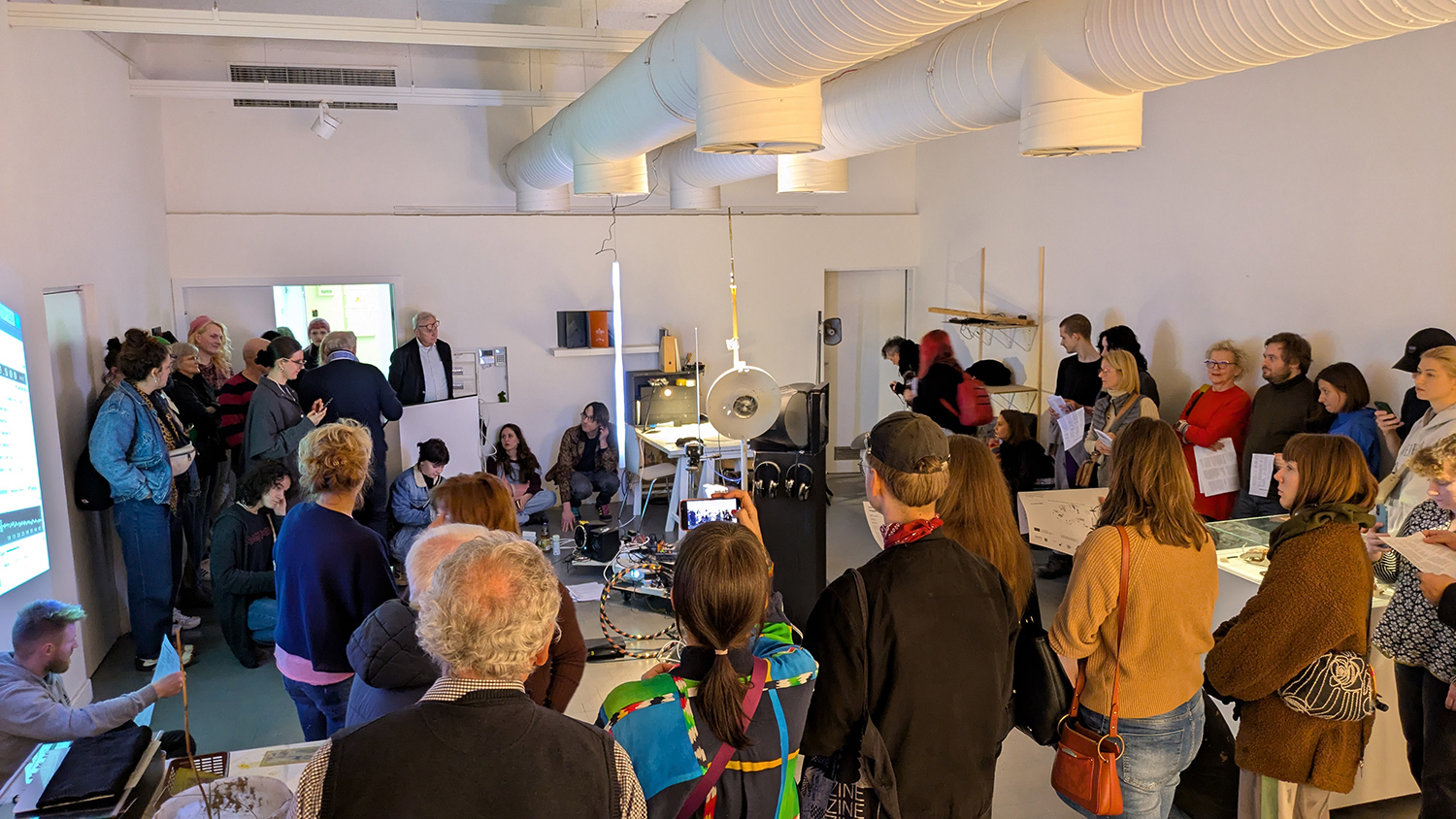
Tosia Pillinow: I’m Tosia and I study Curating and Exhibition Production at the Academy of Art in Szczecin. I’m actually part of the very first BA cohort of the programme. I got involved with the exhibition through a course assignment in an audiovisual studio class, led by Zorka Wollny and Łukasz Jastrubczak. Together with my classmate Julia Hałas, I was assigned to help organize the exhibition alongside the artist Marthe (they/them), who is involved in several Belgian hacker-anarchist-feminist collectives.
During the less than two weeks we spent preparing the exhibition, we got a glimpse into the activities of the collective ooooo. One of their starting points is the idea that electromagnetic fields, despite being invisible, are nevertheless present everywhere around us, and that, like any other resource, they are subject to the power structures of capital, states, and corporations.
We spent days searching for old germanium resistors, which have different properties from contemporary silicon ones, visiting tiny electronics shops around the city. We went to the market in Szczecin and out to Przecław in search of an oscilloscope. So that whole period was filled with little adventures. We even got to meet bacteria capable of producing electricity.
Our attention was also drawn to the presence of 5G antennas, short-range transmitters that are incredibly numerous and woven into the fabric of the city. They’re the reason we have network coverage almost everywhere. We learned that certain radio frequencies remain inaccessible to civilians. It felt like uncovering an invisible layer of infrastructure that is usually hidden in plain sight.
Which elements of the exhibition stayed with you the most?
TB: A copy of the June 1928 issue of Science and Invention. An absolutely fascinating document. Not only was it visually stunning-no AI slop, of course but it was also packed with knowledge and theories. Some of those ideas have become outdated, sure, but not all of them. In fact, some remain remarkably relevant. Reading them today feels less like encountering nearly century-old science and more like stumbling upon secret knowledge left behind by some lost civilization, Atlantis or something.
And yet it was only ninety-eight years ago. On the scale of human history, that’s a moment. On the scale of technological development, it’s entire aeons.
As for whether the exhibition started something for me, I’m not sure. It was more a part of the larger journey that is life (laughs). Jokes aside, it became one element within a broader constellation of excellent exhibitions and events that take place at Trafo.
I’m curious about the community around the Academy of Art in Szczecin and Trafo Station. From the outside it seems quite close-knit and open to experimentation. How does it feel from within?
TB: From a distance, it looks pretty good. But for me and for many people who have moved here from elsewhere, after a while there’s this feeling that a certain kind of stagnation hangs over the city.
Maybe it’s too close to Berlin and too far from the rest of Poland.
The Academy itself is full of brilliant, creative students and professors. But outside of Trafo there’s a lack of venues with a coherent artistic programme, places that have a clear sense of themselves and their audiences. There aren’t many spaces that really bring students together.
There’s only one Trafo. Sometimes it feels as though there aren’t enough resources for self-promotion, or maybe people simply stay home because they can’t afford not to. Concerts and author talks often attract just a dozen or so people. It’s a little sad.
Do you think sound art somehow acts as a connective tissue within that absence?
TB: My relationship with sound art is actually pretty limited. I tend to prefer music. I struggle with sounds that are completely non-melodic and non-rhythmic. Honestly, I could probably count on one hand the sound art works I know. And as I’m saying this, I’m not even sure I could.
My suspicion is that sound art faces the same problem as visual art. It feels like it requires a certain theoretical background, and the threshold for entry is probably quite high. And then there’s a third issue: there’s probably a lot of bad work that manages to slip into the field and muddies the perception of everything else, especially the things that actually have value.
That’s not unique to sound art, of course. But because the field is already niche, the effects might be felt more strongly.
Lullaby-Like Rhythms: A Conversation with Ana Kulak
I have been granted the opportunity to live within the gallery itself, in the Trafostacja, on the top floor reserved for guests. It happened to be Monday, a day when the gallery is closed to visitors - yet I could hear the faintest rustlings of those who continue to work in the building despite its official closure. I felt a strong temptation to wander through the deserted exhibition spaces… It feels like we're behind the scenes…
Would you tell me about yourself and about your relationship with this place?
Ana Kulak: My name is Ana Kulak and I am a visual and sound artist. I work with space, painting, poetry, objects, and sound. I also perform, sing and compose. Recently I defended my Master’s at the Academy of Art in Szczecin. I come from Ukraine and moved here in 2022. I transferred to the Academy in Szczecin from the one in Lviv. I finished my Bachelor's degree and then started my Master’s here, during which I focused on sound art and painting.
What did you study in Lviv?
AK: Painting, but it was an entirely different experience, much more traditional. Here, however, the approach is far more interdisciplinary. I find that very appealing; it suits me well. I have opened up as an artist during these years here.
How did you come to Szczecin?
AK: It was largely a matter of chance and the winding road of my emigration. When the full-scale invasion began, I arrived in Kraków, then lived in France for a while, then came back to Poland and a friend of mine invited me to go to Sokołowsko with her. There was an opportunity to stay there temporarily, so I agreed without thinking twice. I knew nothing about the Polish art scene, how places related to one another and the journey to Sokołowsko felt to me like a small instance of magical realism. Kieślowski lived there; I have loved his movies since I was a teenager. I heard that there was a good academy in Szczecin, and that is how I arrived here. This is the kind of life path that is composed of coincidences and people you meet; through them, in a non-obvious way, you eventually find yourself where you are.
And then you took part in the Młode Wilki Festival.
AK: Yes, we were the Szczecin-based group acting as hosts for the Festival. We produced the exhibition Pentlarium, curated by Dobro Hada-Jasikowska. Szczecin was rendered through sound, captured as something young, sonic, and resonant.
So that was what the exhibition was about? About the young sounds of Szczecin?
AK: The exhibition was about the concept of the “loop” and various forms of looping. We tried to approach it from multiple contexts and considering both history & the nature of sound itself, including the traditions of looping and sampling.
There was an amazing piece by Sonik Landsberg, who built a whale’s mouth that one could enter, even lay down inside and it resonated from within. Andrej Kharchanka presented a monster made of trash, while Aleks Libertad created DIY speakers from garbage, playing the Rhythms of Resistance. Radosław Hada-Jasikowski presented a kind of divination device containing technology which people could interact with and it also reinterpreted the oldest notated musical song Hurrian Hymn.
How did you work on your part of the exhibition?
AK: I presented a sculpture that referenced both breath and visions of the future, in relation to ecology and the ways in which organisms could mutate. It is an abstract form that resembles ribs from which you can hear the sound of deconstructed breathing. Another work I presented was an installation made with fabric, which touches on the topic of existential loneliness. It was a canvas suspended from the ceiling. Along its edges, there was fabric (three meters long) which created an intimate space, isolating the viewer from the surrounding environment.
When one entered the installation and looked up at the canvas, the voluminous fabric floated around, and a sound piece began to resonate. I wanted to vocalize my painting, so I recorded a composition by overlaying my voice. Because the painting contained a spiral, the sound took on a lullaby-like melody.
You mentioned that this happened some time ago. What have you been working on in the meantime?
AK: I defended my Master diploma and this year I also participated in a mini-residency at GEMEA in Albi, France. It was a week-long residency where we explored the city of Albi, focusing on the theme of the city and sound installations in urban spaces, as well as performative actions. It was a wonderful experience and taught me a great deal. This residency was a part of the tekhnē project. Each participating institution recommended young artists who are connected to them to join this residency. We were there as young sound artists coming from different places around the world. Most universities in Europe offer studies in sound production; for me, it was mainly workshops at Trafo that opened me up to sound art from its technological side.
You also participated in tekhnē workshops with, among others, Passepartout Duo, Jasmine Guffond, and Jenny Gräf Sheppard. What was your experience like in those cases?
AK: There, artists would show us fragments of their own work or the methods they used to create them, for example, using instruments or technologies. These were more hands-on, active workshops. Tekhnē here in Szczecin has an educational component: the artists come for the residency and share their knowledge and experience.
Where do the themes you mention in your work come from? Do you focus on what you notice around you, or do you draw more from your memories and the here and now?
AK: It depends on the work, but lately the themes that have lingered with me the most are those concerning the vision of a future and ecology, space exploration but also connection with nature on Earth. I am opening my solo exhibition this Saturday at Terminal08 in Gorzów Wielkopolski. Works from the Młode Wilki Festival will be presented there as well .
Where do the themes come from? Maybe ideas crawl into my head while I sleep…
Afterwards they burst out of me as cries, sometimes as reactions to what's happening politically, sometimes from the depths of my inner searches and experiences. Uncovering these living impulses allows me to speak about what’s important. I believe that art is a place to be wild and poetic.
What are your plans moving forward?
AK: I plan to focus more on sound art and singing in the Red Mountain Projekt ( that my friends and I do together). Artistically, I would like to release some of my sound works, because I already have a lot of material. So I am looking for opportunities to publish or share something in the sound domain.
And do you want to make music yourself? Music… I’m not sure if that’s the right word.
AK: I often find myself wondering which word to use.
Do you have any favorites?
AK: I prefer to name it as sound spaces or compositions.
Do you still paint, and how does it connect with sound in your work?
AK: Yes, sometimes. With painting, I am interested in movement, a certain kind of performativity. I’ve been working with spray paints that create an exceptionally dynamic effect. I also scatter small objects across the canvas, which I feel is a very sound-like action. For me, this connects with gesture and movement, which are also essential in sound.
Do you have certain artists or works in the back of your mind, perhaps ones that have shaped you? Or do you prefer to work without such references, doing what you feel?
AK: I mostly follow what I feel and intuition that appears while creation. I also work a lot with trash and found objects, transforming them in some way and redefining their contexts. But all kinds of music have always been the main sources of my inspiration. Music allows me to “dream” about a visual piece. Or the other way around.
Bio:
Natalia Piotrkowicz (PL) holds Master’s degrees from the Faculty of Artes Liberales and the Institute of Ethnology and Cultural Anthropology at the University of Warsaw. She is also a graduate of the Ethnofest Film School in Athens and the Andrzej Wajda School of Film Directing in Warsaw. As Projekt Galatea, a collaborative practice with Hanna Dzięgielewska, she works at the intersection of research and artistic practice, exploring the social and cultural lives of objects and the ways in which objects carry, preserve, and shape stories. Their collaboration has so far resulted in the development and direction of the documentary film Ubrania Nie Kroisz Według Cienia, which examines the PRL through the stories embedded in clothing and material culture. Since 2022, Piotrkowicz has been a member of the Glissando editorial collective, where she explores sound art and film music.