 Editorial
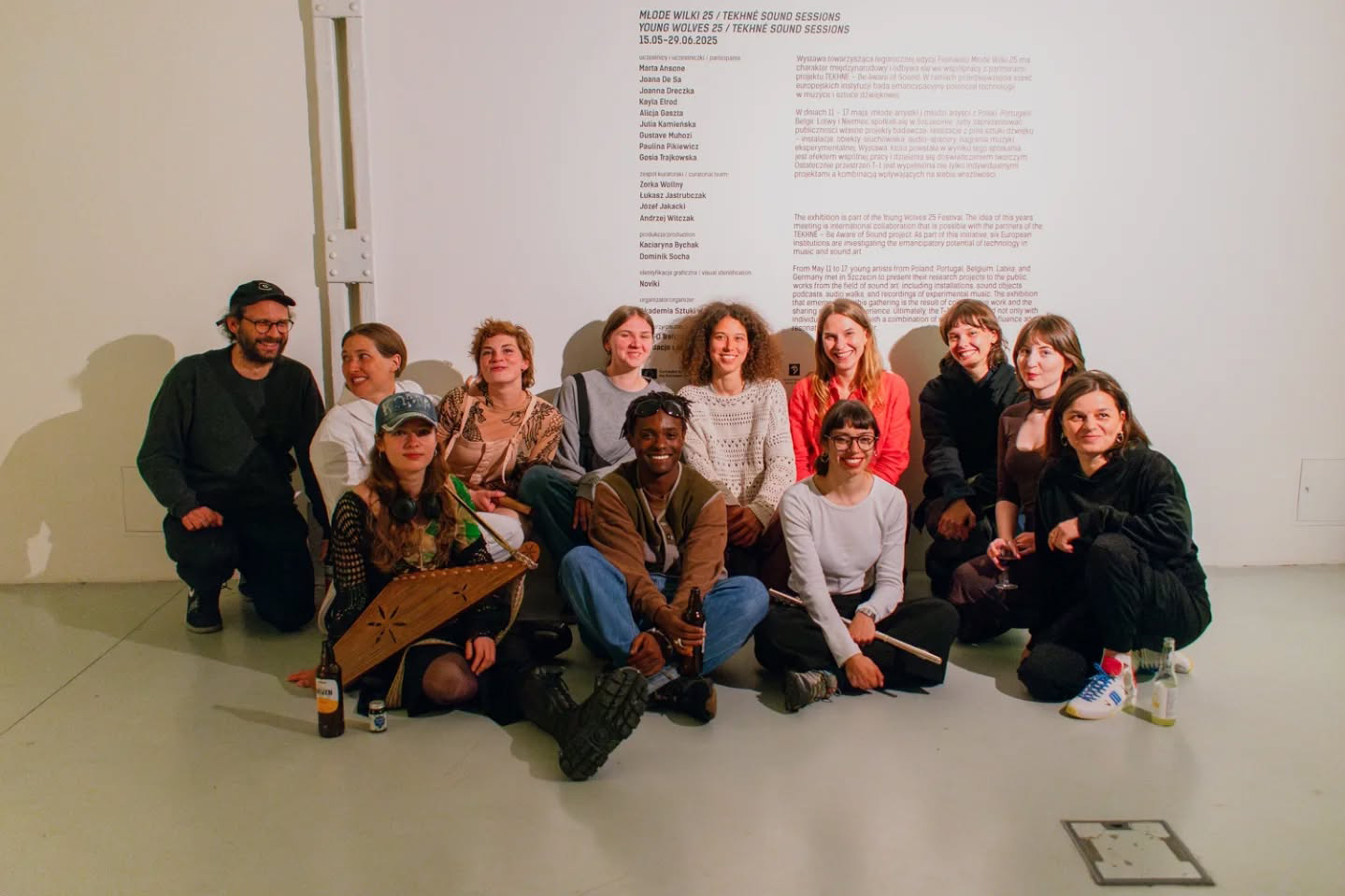
Sound Narratives: Conversations with the Participants of the 2025 Young Wolves Festival
In May 2025, Szczecin saw the 20th edition of the Young Wolves art festival, organised by the Szczecin Art Academy. That particular edition was devoted to sound and organised within the framework of tekhnē. It became a meeting point for young artists engaged in sound art and experimental music, who presented their intermedia works in the form of sound installations and objects, audio dramas, and sonic performances. The festival was largely driven by spontaneous collaboration among the artists, which led to an active approach to the composition of the exhibition space, and fostered the formation of a temporary collective of sound performers. For years, the festival has consciously moved beyond institutional frameworks, intent on not only presenting artworks, but also shaping the space for activities at the intersection of experimentation and improvisation – suspended between theory and practice, participation and observation, contemplation and action, individual work and collective creation. The 2025 edition encouraged an exploration of both the sensual and material dimensions of sound, as well as storytelling, narrating the contemporary world through the lens of the auditory. The conversations I’ve had with the artists-in-residence are an extension of the process of mutual resonance of their individual sensitivities and perceptions, as well as an attempt to narrate sound as a particular kind of medium in which the non-linear trajectories of narratives are tied to the principle of radical relationality. The ephemeral collective worked during the festival on an unplanned collective performance and afterwards demanded a collective interview.
Artists-in-Residence:
Alicja Gaszta - AG
Joana De Sa - JDS
Marta Ansone aka OFAE - MA
Joanna Dreczka, Justyna Szewczuk - JD
Julia Kamieńska - JK
Kayla Elrod aka PLZ KRUSH - KE
Paulina Pikiewicz - PP
Gustave Muhozi - GM
What can you tell me about your projects?
PP – Bagnisko 4: Trzęsawiska władzy (Bog 4: Quagmires of Power): The work presented at TRAFO is something I’d like to continue pursuing in the future – playing with sound design, creating sound for installations. I’m drawn to crafting soundscapes for non-existent worlds, characters, spaces. The joy that flows from the unrestrained process of trusting one’s sonic intuition is vital for me. While working on Bog, I knew what kind of structure I wanted to create, referencing the games I grew up with. It was helpful to imagine a character whose personality I wanted to convey through sound. When you regularly play a game for hours at a time, the sounds that appear in it become lived to the point that hearing them again later is like repeating lines from your favourite films. The richness of sound as a medium is fascinating to me – it can be both a simple message or something more complex – something capable of pushing the story forward, becoming a part of the world as such. The space which sound design provides proves so abundant that I want to use it as my artistic material.
I have a background in radio so I didn’t call myself a sound artist for a long time. It’s still something that’s only slowly coming to me – I’m starting to understand that I want to adopt a more art-oriented approach to things. I like playing with the meanings inherent in sound, and through Bog, I’d like to provoke exercises in worldbuilding. I’m also tired of the radio medium which requires a lot of time being closed off in the studio, transmitting content via the Internet, cut off from live contact with the audience. Therefore, in Bog, I focused on creating an interactive experience to enable a relationship with the audience. The extra-musical elements of the installation are also a part of this – a statue model that people can touch, playing cards that can be picked up and read, the odor of the bog that can be smelled. It was crucial for me to gather people for collective listening. And I want all of this to have a humorous aspect, for the experience to be joyful.
What happened later on with Bog, I had practiced earlier through the production of jingles for my experimental radio programmes. I’d play with words, being on-air, and this brought me so much joy that when the opportunity arose to realise the project in the Department of Sound Katowice, the first idea that came to mind was to design the sound for a non-existent game. The game may not exist, but what the sound communicates about it seems real enough for people to want to play it.
JD – Just Transformation: This work conveys the soundscape of the Bełchatów Coal Mine, which is to be flooded in the future. At first, I went there in connection with a different project. I needed a few film stills with a postapocalyptic feel. Sound surfaced last, and it turned out to be the most interesting part of the installation. The mine’s surroundings are loaded with sound that is actually in a way liminal, barely audible – experienced easier through the recording. Tiny troughs, which are the main element of the installation, symbolize the mining equipment. They have a synthetic look and their shape and motions relate to the weirdness and a kind of absurdity of the mining machinery – when you pass by bucket-wheel excavator, you’re not entirely sure what it’s supposed to be doing, what its use is, but still, you automatically associate such machine with this kind of space.
KE – Fashion Slow: At first, I wanted to present a different work, but my concept changed. In my process, I follow what excites me, not what I’ve planned beforehand. During my visit to the Szczecin Art Academy, I came across a beautiful pair of shoes designed by a student, Magdalena Bylewska, who has since passed away. In her work, she combined a fascination for fashion with ecology, making use mainly of recycled materials. I got the idea to utilise those shoes in my audial performance which revolves around crush fetish. The sound of materials and objects crushed by these shoes evokes various, often extreme connotations and reactions. Fashion Slow puts weight on issues connected to the so-called politics of walking. The way we move says a lot about our identity – both in the context of social class and gender. Also, the limited access to goods and services fuels desire, and this is also something I explore in my work – the audio drama plays out in an intimate relationship between the listener, who sits in a chair and puts on headphones, and myself. The gestures I make and my movements signal the presence of sound that the audience can only access through the act of watching.
JDS – Moss Landing: In my work, I use stone as an artistic material. In my video, I present an archeological site, featuring megalithic structures and various kinds of fossils. My goal was to reinterpret this place through the media I employ – yet not through field recordings but rather the manipulation of organic sounds. It builds on research on archaeoacoustics through a poetic, artistic interpretation. Across my work I also wanted to point out another ecological issue: in the vicinity of the archeological site, quarries were built, which pollute the area’s soundscape.
AG – to the birds I’ll never hear: This work is part of my artistic practice of focusing on wandering, of studying places and situations from various perspectives – auditory, visual, and in this case, also political. My current activities stem from my studies at the Arts Academy where for a long time I searched for a form and method that would feel right for me. My work with sound began with researching, taking photos, recording videos, through gathering materials and writing, to sound recordings – a part that is crucial for me. This, in turn, led me to discover sound studies, and, above all, acoustic ecology. I don’t always achieve a substantive result with my approach, but it gives me groundwork to which I often return. Although to the birds I'll never hear is a rather analytic work, I very much appreciate its oniric, ephemeral, and sometimes mysterious potential that it holds; and I think the direction I’m heading towards combines the possibilities of both these approaches.
JK – Czy my się kiedyś skończymy? (Will we ever come to pass?): This project is the outcome of my three-year journey with photography studies, during which I was searching for my own artistic language. Although I was formally working within the realm of photography, sound and text were very important from the very beginning. Each project would take on a different form but each time I started with visuals and tried to sneak in sound, music, and words, usually resulting in video works. Then, at some point, I noticed that the visuals started dominating texts and music, so I discarded them. This is how the installation I presented at Young Wolves came to be.
MA – Crawling and Nesting: This was my first residency ever. I immediately felt accepted because we could do whatever we wanted to. I liked how there was no exact plan for this exhibition. We were open to everything that might happen during this week, and thanks to that, I didn’t feel under pressure. During the residency, I felt compelled to enrich my sound art with visuals. I gathered various objects from around the hotel where we were staying: rocks, cigarettes, branches, moss. I made an installation out of them by one of the pillars in the exhibition space. It was an entirely intuitive process – the collected objects were ones which resonated with me in the given moment. And the output looks like an album cover in 3D, a real sculpture.
GM: I do film and photography, but music has always played a major role in my life. A significant element of my compositions are fragments inspired by poetry and the visual arts, which I have tried to present at the concert on the opening day of our exhibition.
What is sound to you?
JD: Sound carries information about a given place and its atmosphere. Through engaging with sound art, I discovered that how I feel in a space is directly tied to the sounds that fill it. This was both the case with Bełchatów Coal Mine and my room in Szczecin hotel, where the air conditioner buzzed so much that I felt like I was on a spaceship. Working with sound changes how a person hears the surrounding world, and how they themself change. You start to hear more, so you can divert more attention to the sounds that earlier escaped your perception.
GM: Sound is something primal for me. I was always fascinated by how, at the intersection of word, sound, and image, different meanings arise.
JK: I feel that for me sound is a stimulus that can evoke specific emotions, but it can also come into touch with the world.
AG: The older I get, the more I try to listen attentively, and I’m learning to do so with increasing awareness. I mostly draw from my surroundings, so it is important for me to allow the sound to resonate, and to treat it with the appropriate respect.
JDS: Sound is communication. Sound is about communication.
KE: I wonder why we even ask that question. During my studies, I spent a lot of time proving that sound can be treated as a serious artistic medium. I was often met with the academia’s peculiar attitude towards artworks labeled „sound art”. It gives you something to think about.
PP: Sound can be a refuge, a way of communicating and interacting with reality. I’m still searching for my artistic path, and I know that sound is a medium I like very much and want to develop. There is also an element of staging in all of this that I find very inspiring, of bringing figments of the imagination to life through sounds. My challenge is to produce a sound to describe something that doesn’t exist, which hasn’t been created. Maybe this stems from my fatigue with field recording.
Do you use sound to tell a story, weave your own narrative, or is it rather about attentive listening to the world and amplifying the process of exploring the various properties of sound? What is more essential to your work – recording or creation?
PP: It varies, interchangeably – I open up an audio editor with a few empty tracks, and sound comes to me, determining subsequent elements of the story. A narrative has to arise for a form to be possible, because it’s the former that helps envision the sounds of the world and its characters. I don’t want to just settle on the realistic aspects of sonic material. If I record the sound of fish fins fluttering in the water, I want that sound to lead me to further ideas I can realize through my artistic craft. Simply observing and recording reality isn’t enough for me. It’s important to use the potential of natural sounds to suggest the fantastical aspects of reality.
JD: When it comes to sound, the primary and fundamental activity for me is recording. Sound art differs from making music in that you draw a lot from the environment. The first aspect is attentiveness – you discover a sound you like, and only then do you respond to it by making modifications. It’s not really about creating a separate story, but rather highlighting something that already appears in the recording, and filtering it through our perception. While I enjoy the possibility of slight modifications and tampering with the material, “pure sound” remains for me the starting point.
JK: I definitely lean more towards creating stories than listening to reality.
JDS: Some of my narratives are based on what I hear. If I listen to a sound it may, but doesn’t have to, become part of the narration in a piece. Simply the act of listening can generate a narrative. And sound itself can be narrative. Spoken word and concrete poetry play a major role in my work, and some of the texts are freely flowing phrases that form part of the message I want to share with the audience.
KK: I couldn’t separate narration from the act of listening, it’s a neverending process. I love practices that can be called performative interventions into the world of sound art. I feel my work becomes more interesting if I do a sound performance rather than just a performance. Sound gives performance a new dimension.
AG: I’ve mentioned that I’m learning to listen more and more attentively, but I also like to craft stories, write, and take inspiration from literature. Artistic creation gives you an opportunity to both put yourself into the work, and leave space for the others. Stories and recordings can interweave; and a recording, depending on the intent, can be an act of appropriation, or giving space.
MA: I feel that at the beginning of the artistic process I try to pour out various ideas, and then I look for a sound that would correspond with them. If I want to experiment, I sit in front of the computer, and the experience is entirely different – sometimes I start without any ideas, which only gradually crystallize as I seek different qualities of sound, and eliminate elements of the emerging composition. So, what I want to tell is found in the process.
GM: I’ve always been fascinated by the narrativity of words in music. Recently, I’ve been inspired by the works of Ludwig Wittgenstein, because as a poet I too am interested in language, and how meaning is created in the interplay between words. I am especially absorbed by what lies at the intersection of words, meaning, and sound.
During the residency you had the opportunity to not only work on your own projects but also to create a space of dialogue and spontaneous interactions during improvised sessions. How does the experience of working with sound differ depending on whether you work individually or collectively?
JD: When people come together, something more than just the sum of individuals arises between them. Collective work is both the relation between individuals and whatever they spark in each other. Collective art is a story about connection, and working with others can allow you to take a lot from them, which then carries onto individual work. You find things activated within you that otherwise wouldn’t have emerged, as there would be no one to bring them to life.
GM: When I was younger, I mostly engaged with music in solitude, which enriched my inner world. That later changed when I began to take part in collaborative actions: we formed a collective with friends, I joined a choir, and entered into various artistic collaborations. These experiences showed me that music is an inseparable part of interpersonal communication, as it allows us to be a part of a greater whole. I felt this during our improvised sessions – sharing your inner world with others is absolutely beautiful.
MA: When working with others, you can’t just follow your own vision: you must develop a collective one, and that is something that can’t be fully planned. You realise that it isn’t about you – and your ego has to be surrendered. It’s amazing how that state can be achieved through music. I feel that it’d be harder if we were visual artists. Music is a special art form for me because it allows us to communicate on an abstract, subconscious level.
AG: I’m quite an introverted person who likes to work in silence and at my own pace. I really enjoy creating at home or in my hometown – there are a lot of green areas, as well as the sea. Given my interests, these places give me inspiration and space to work, encouraging in-depth analysis and precision. Yet, with this type of approach, nothing teaches more than the confrontation with the work of others, and creating something together. I really enjoyed Young Wolves in this aspect – we got in sync with each other, combining our truly distinct approaches and voices, listening to each other, and leaving enough space for everyone’s voice to resonate. I try to approach my relation with nature in a similar way, treating the creative process as a collaboration.
JDS: It’s always good to work with other people because it helps you to learn faster, as your perception sharpens. During our last jam session, we were all very connected; you could feel just how closely and attentively we were listening to each other. Individual work is easier – you don’t have to wait for anyone, you’re totally free. Also, when I work in a group my self-esteem drops quite quickly. While working alone, that problem disappears – it’s simply myself I let down.
JK: Teamwork forces you to listen to and learn from each other. It is sometimes intimidating – I do fear that I will dominate the process. When I work alone, I have more courage to experiment and follow my intuition. It’s easier to express myself and not fear being “too much”.
KE: Sound ignites play in the group, creating the mood for honest conversations and interactions. I’m glad to have the opportunity to get to know the local art scene and its artists: to learn what is important for them, and how they deal with common problems.
PP: Working in a group requires a different kind of focus. You can spend more time polishing nuances while working alone, something that’s hard to do while working with others. You have to get rid of your perfectionism and the need for control, learning instead to enjoy creating with others. Individual work involves constantly surpassing yourself, while group activities are more about the interchange of energy and play. The “self” dissolves in a group, one stops feeling their own weight, and that is something invaluable.
Which qualities of sound resonate more within your art – its materiality and physicality, or rather its intangibility, ephemerality?
PP: It depends on the context – in a group situation we deal with the intangibility of sound, everything is happening “here and now”. This requires an intense sort of listening because you are aware that any given sound situation can disappear the next moment. When I work alone, the texture of sounds fascinates me, and just how malleable it is, and this resonates in the miniatures I create. I work with various aspects of sound – it can be scabrous, pleasant, disgusting. I contemplate which sounds I can use to achieve the right texture or a specific effect.
JK: It’s surely intangibility for me. Especially with how it’s not always entirely clear how and why sound works.
AG: Definitely intangibility, since it leaves a lot of space for the imagination and a sensual perception of reality.
JD: It’s hard to say that ephemerality of sound still exists since everything is being recorded now, but I like how sound evokes strong emotions, and it’s not always clear why and how that happens.
KE: These two aspects are inseparable for me. The process of exploring objects through sound and sound through objects is thrilling.
MA: They’re inseparable. I enjoy “sculpting” in sound, shaping it. Harmony is of primary importance to me – not in the sense of chord progression, but in creating a sense of coherence – harmony on the very level of sound frequencies.
JDS: I’ve always been taken with the materiality of sound. However, I aim to capture the moments in which this materiality gains something ephemeral, revealing substantive properties of time and space.
GM: I think I'm interested in both qualities, but I have to admit that I do have a certain fondness for a very visceral, physical experience of music, even though my more recent work has been more abstract, focusing also on language.
All of you work at the intersection of arts, drawing inspiration from various artistic and scientific fields. How is visual work different from working with sound?
JD: Visual work is divided into two stages. First, there is an intimate dialogue with yourself; then, you present the result of your work to others, which makes it more stressful for me. There is a strict division between the stage of creation, and being subject to evaluation. A painting, sculpture, or installation feel like a pane of glass that separates me from the world. Sound, on the other hand, has more communicative qualities, it can be made together, instantaneously, which makes it more direct. In all the art I’ve made with any of the collectives I co-created, there was always an element of spontaneity. Working with sound seems way more social. Because sound is abstract, it’s less likely to become cliché. While painting, you have to make motions which are specifically yours. With sound, which you take from nature, it’s easier to hide yourself – you’re not as exposed, so you feel you can say more.
GM: I believe that sounds and images often work in a feedback loop. Sometimes, when we look at an image, we hear sound – and vice versa, we see an image through hearing sound. One of my biggest inspirations for creating music was Derek Jarman’s film Blue. As a response to losing his sight, he created a visual work reduced to a blue screen, in which the main role belongs to the narrative layer of sound.
JDS: The skills I honed when making visual arts – drawing, photography, and graphic design – carried onto the methods that I use in my compositions. I sometimes create graphic scores and interpret them sonically, and vice versa – I compose first and create visual forms based on that. I believe that sound stimulates visual imagination.
KE: I use sound as a tool for exploring the materiality of objects. I obtain sound through touch – by rubbing or tapping. I often work with my eyes closed to maximise my auditory imagination. Sound is, for me, the essential driving force upon which I build the subsequent elements of my work.
AG: There’s no difference for me. I treat my visual and sound works as a coherent whole.
JK: Images are way more demanding – you have to plan, think it through, care for every detail. Everything needs to explain itself. With sound, I feel there’s more liberty. It’s easier to build a narrative and not feel that I have to explain my choices.
PP: In sound, I can lose myself, enter into a trance. This is not something I often feel working with visual media. Sound is primary for me in the artistic process but I know that there are no “pure” situations, which is why intermediality is important to me – the visual and performative aspects all interlace. Sound is malleable enough to allow for the interweaving of various forms of expression. Sound is total – the fatigue felt after working with sound is greater than working with visual media. Working with sound requires focus. This focus causes you to become sound.
What role does technology play in your art? Can you imagine working with sound without the use of technology? Or is it always present in various forms of mediation?
JK: Technology plays a big role in my project – I modified my voice with AI, made use of sound effects, and the lamp I use in my installation had to be programmed. Despite all that, I can easily imagine working without technology. It would definitely be more time-consuming, but perhaps because of that – more attentive and present. Actually, I do love traditional folk music, especially white voice singing (pol. biały śpiew) which I associate with “natural” sound – raw, bodily, close.
KE: I used to be part of the LOAD collective, in which we addressed the issue of “technofetishism” as hegemonic in sound art. We wanted to resist it through acts affirming the role our body has in listening, proposing various exercises through which sound facilitates entering into a harmonious relation with your own body.
GM: I think I’m very fortunate to live in a time where the accessibility to modes of playing/processing sound is so broad, thanks to current technology. It actually makes you see and learn ways of doing things that you can later implement even without the tech. I personally use new media in my work, but it is not a necessity. I’d still be able to go deeper within my work even if I were not able to use “technology” – although it’s a bit hard to say what is and isn’t technology: flutes, computers, programmes, etc.
MA: Recently, I’ve been more and more interested in the acoustic sounds: voices, guitars, and traditional instruments like the kokle, which I have brought with me. I’m also fascinated by analogue synthesisers – the quality of sound that you can get from them is something programmes like Ableton can’t achieve.
JDS: Technology largely assists me in composition. Without it, I’d probably create more visual media.
PP: I’d like to develop an analogue approach to thinking about sound. I’m sick of working at a computer so I appreciate the forms of movement that involve sound, like dance or soundwalks, and I try to make use of forms of expression that don’t require mediation by technology. The beauty of sound lies in the fact that it never exists on its own – it’s always in relation to something. Sound recorders and other technological devices can then just serve to equip the ear, acting a bit like LSD – you hear more and feel more.
JD: I admire the rawness of analogue sound. When you add modifications through digital electronics, it takes on a different quality; but loudspeakers, recorders, and microphones remain a key part of the artistic process. The way you record and play sound is crucial to the success of the project. Our equipment teaches us how to listen, our perception deepens. I’m able to isolate elements of the environment more precisely thanks to the experience of sound recording.
AG: It’s quite amusing – I’m not really interested in technology but most of my art operates thanks to it. I prefer to treat it as a tool that allows me to work with my surroundings, to create and materialize the products of my imagination. I’m not an expert, and I feel I still lack some technical skills, so I spend lots of time studying tools and techniques. I want to get to a level that will satisfy me, but I also wouldn’t want to set artistic practice aside just because I’m still learning and feel insecure. I like the space that my computer, microphones, and my field recorder give me – I can’t imagine working without them, sort of like I can’t imagine working with pictures without photography. Nonetheless, I still treat them as tools, not as part of my artworks.
For me, sound is always in relation to other things, kind of like being a question or an answer, depending on what you might need or are searching for at a given moment. I’d like to treat every sound as pristine, because each is unrepeatable, or perhaps we (as a society) shouldn’t even assess which sounds are clean or pure, and which aren’t. I am impressed by those who don’t use technology and just experience the situation – the performance – knowing that what is happening right now will happen only now, and they’re able to carry that across to the audience. I don’t think I’m able to do that, and as a person who doesn’t like to perform, I’m very grateful that, thanks to technology, I can also continue to work with sound.
Bio:
Weronika Bielecka (PL) is a vocalist, cultural studies scholar, vocal coach, musicology student, and graduate of the Faculty of "Artes Liberales" at the University of Warsaw. Member of the editorial team of “Glissando” magazine.
Additional translations by Ula Świątek.