 Editorial
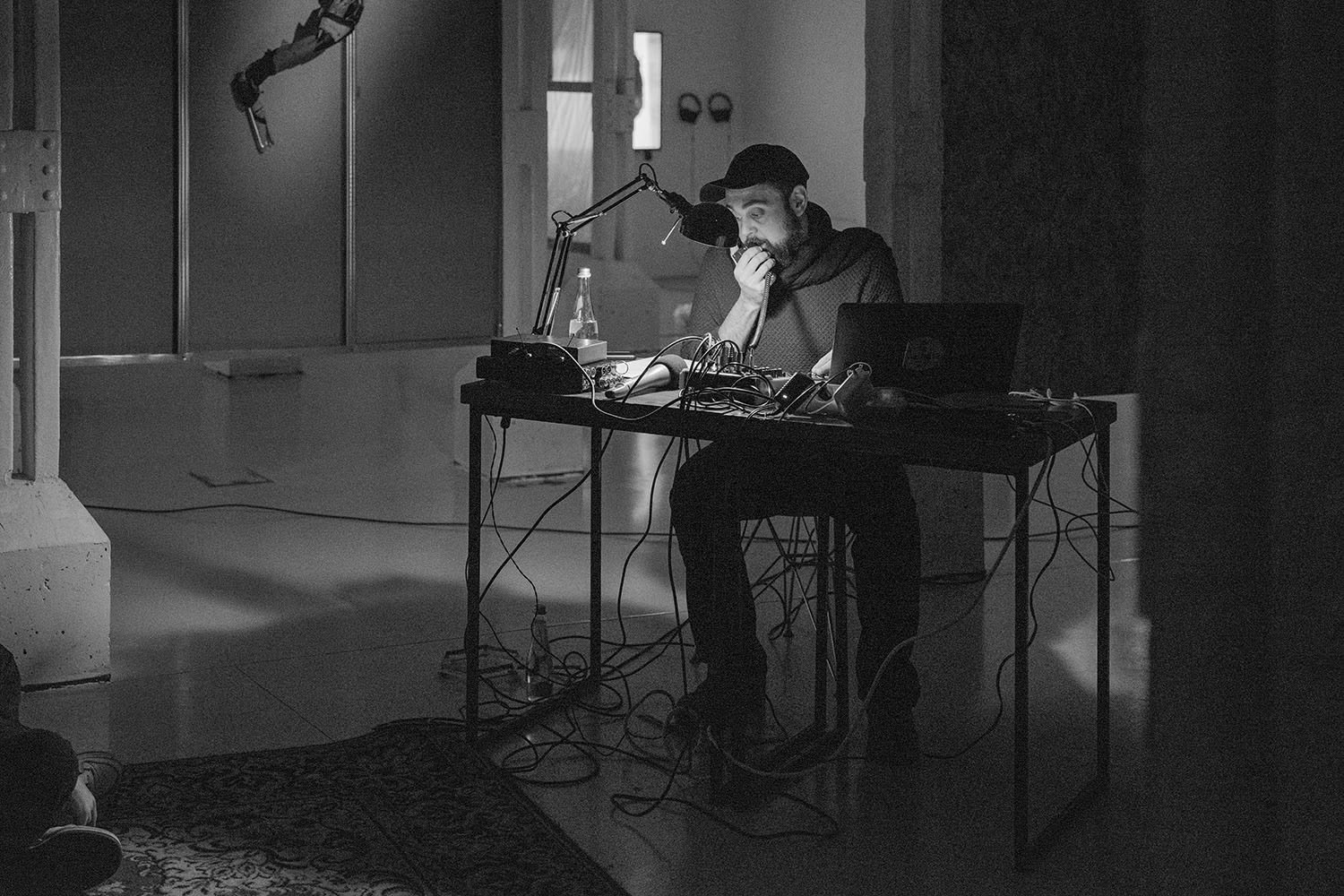
Radio Silence
This story does not start with radio. It comes from another medium – one that today feels ordinary, almost invisible: the internet. Over there, I came across reports of mysterious number stations broadcasting from Kasprowicza Park in Szczecin during the Cold War, and of a jammer that disturbed the city’s vacuum-tube radios, unsettling the domestic soundscape during the 70s and 80s. But first: what is a number station?
From the Cold War onward, specific shortwave radio frequencies carried sequences of numbers, words, or encoded messages (like the one you're listening to now) at specific times of the day. By radio, I don’t mean the local FM stations we hear in the car or in the kitchen – Shortwaves is a different world, a world of signals traveling around the globe throughout electromagnetic highways, but that can still be received on many consumer radio sets.
Among other users, Intelligence Services employ this worldwide network to reach their operatives in the field abroad, sending them instructions in cipher. What makes these broadcasts uncanny is the blend of the ordinary with the mysterious: picture a simple radio set in a living room, and then – suddenly – imagine a monotone voice spelling out numbers, sometimes layered with signal tones, electronic beeps, or bursts of static.
What you are listening to is a recording I made on February 10, 2026, from my apartment in Szczecin at 06:45 UTC, on 23031 kHz frequency. This is E11 – also known as “Oblique” – a numbers station still broadcasting on a regular basis from a military facility located in the village of Chotomów, north of Warsaw - a site operated by SWW, Służba Wywiadu Wojskowego, the Polish Military Intelligence Service.
According to the blog Służby i Obywatel, in response to the rising political tensions in the area, the activities at the Chotomów radio facility appear to have changed drastically in recent years: security has been increased with armed patrols and restricted access, and the site’s infrastructure, including the antennas, has been hidden behind tarps along the whole perimeter. Reports like this suggest a shift toward greater operational secrecy.
The same blog hosts a very detailed map of Polish intelligence service installations. I was quite surprised to discover that Szczecin area counts eight sites, including offices and other unidentified buildings: two of these, that look like private homes, are situated directly across from Kasprowicza Park. This definitely renewed my enthusiasm!
I spent long hours walking through the park, in search of strong signals on my radio scanner, as well as sniffing around with my EMF microphones – handmade devices able to pick up all kinds of electromagnetic fields. But all I could record were traces of public electrical currents running here and there across the park, and a few deeper sounds coming from a junction box, basically what you're hearing right now.
To give you a sense of how these kind of microphones 'come alive' near more complex devices, I’ll place them close to the electronics currently on my table.
Nothing even close to this was audible in the park. Even my attempts to contact local amateur radio operators – the only people who might have been able to tell me this story properly – came to nothing. Nada.
Radio silence.
But when it comes to radio, what we call silence is a matter of perspective. Technically there's always some signal on the airwaves – a playful echo of John Cage or Raymond Murray Schafer..
The iconic writer William Burroughs used to keep three off-tuned radios hissing static noise in his room in Tangier, Morocco — not tuned to stations, but tuned to possibilities. The point for him was not to receive messages, patterns, or inspiration: the static noise broke the traditional model of communication, turning listening into a space of relation, where presence and interaction exist without a language or a stiff sender-receiver structure.
This idea – that listening can transform a space into a field of relations – has stayed with me for years, woven into all my listening practices. Through my previous projects, I have long engaged in close, attentive listening to physical spaces, often focusing on micro-worlds, as a practice capable of subverting canonical cartography, which typically relies on a predatory view-from-above, that favors distance over presence.
By contrast, I’ve learned from Donna Haraway or Brandon LaBelle that knowledge and listening are always situated and relational, attuned to layered, unstable territories and the fragile connections they contain.
But in order to get rid of the map, we need to know everything about it – and we must be careful not to mistake the map for the territory itself.
I’ve always been attracted by sounds, but I rarely paid attention to signals – even though they surround us everywhere, all the time. We surely know how a bird sings, but many of us have never heard the whistle of the magnetosphere drifting through the air, or the soft droning of FT8, a type of digital-data radio transmission.
In order to understand what these signals are, how they are generated and how they propagate, I felt the need to rely on a sort of imaginative topography that would allow me to navigate this radio-scape openly. I drew direct inspiration from the stunning work of the Italian anthropologist Matteo Meschiari, whose idea of counter-geography presents maps not as tools of power or quantification, but as a creative and critical vision of space.
A heterotopic territory emerges from here: an archive in tension, where human-modulated signals, and more-than-human energies interact.
The idea that we are constantly entangled in electromagnetic fields starts from the concept of animal magnetism, formulated at the end of the eighteenth century by physician Franz Anton Mesmer. Mesmer described an invisible fluid permeating living bodies, the Earth, and the cosmos – a continuous field of forces that could be transmitted, disturbed, and modulated.
Mesmer’s work deeply influenced my thinking, shaping the idea of the body as an antenna – conceptually, the perfect vessel for navigating the invisible map I referred to earlier. From this perspective, the body is no longer a closed entity, but a receptive surface, entangled in a wider field of forces – sensitive, and relational.
But where do we begin to drift?
Where to follow these signals into the sensory world?
After the meager results at Kasprowicza Park, the harbor in Szczecin was the first place I focused on, aware of the invisible mesh of signals floating through the air, carrying everything from weather forecasts to military transmissions. Harbors are way more than docks and cranes – they are landscapes of vibrating electromagnetic fields.
With a digital radio scanner and a seven-meter long-wire antenna, I happened to receive a NAVTEX message on 518 kHz at 13:20 UTC on February 1st, 2026. NAVTEX is a maritime service sending navigational warnings over radio frequencies. With a digital decoder, you can turn the sonic signals into readable text – this one alerting ships in the Baltic Sea about low water levels, while also warning that the southern Baltic coast, northeast of Jarosławiec, is closed for military exercises.
Among the many frequency bands connected to water environments, one of the spots I like the most is 180 kHz. This is not strictly used for radio broadcasting, but rather for underwater acoustic telemetry – tracking fish and marine life through miniature transmitters in both fresh- and saltwater. It is widely used in scientific research to study movement, behaviour, and interactions within aquatic ecosystems. Though not directly audible, these signals can become perceptible through radio receivers using a special conversion. What makes them so fascinating is the striking contrast between their delicate function and the harsh sound they translate into for our ears.
But before we get lost in the broad spaces radio-oddities, I’d like to step back for a moment and remark that the history of radio begins long before it was invented. Radio was heard before anyone knew it existed, through the telephone line. The first person to hear radio was Thomas Watson, Alexander Graham Bell’s assistant, who listened on a long metal line acting as an antenna – before antennas were invented.
Back in the late 19th century, along telephone lines, people could hear the electric whispers of storms, or the flicker of distant lightning – natural sounds that existed before any broadcast, before anyone knew they could be heard. This is what I will call from now ahead Radio Natura, a term I borrow from the Italian researcher Renato Romero. These sounds move along very low frequencies, traveling across space to anyone attuned to listen.
What you are listening to is a recording I was lucky enough to collect directly through my shortwave radio during an harsh geomagnetic storm, in the night of January 8, 2026 . The pops and crackling you hear are called sferics, short for atmospherics – brief bursts of natural radio energy generated by lightning striking on Earth. This make it clear that a radio transmitter is not always a technological device powered by a battery or a wall plug; sometimes, radio is the energy itself. Receiving it may mean someone is listening, but it does not always mean anyone is sending. So, different parts of the globe are already in wireless communication with one another in an expressiveness of storms.
But the history of telecommunications tell us how we cut Radio Natura out of our listening. These subtle hums and crackles once audible through the early telephone lines were dismissed as trivial interference – technology worked hard to silence them, erasing a vivid sonic eco-system from our ears. Nevertheless, There are still ways to attune to Radio Natura beyond standard radio devices. I’m currently experimenting with large loop antennas plugged straight to a portable recorder, set far from the city’s hum, allowing these phenomena to reach us in all their subtle wonder.
The material you are listening to was recorded in the Italian Alps using a homemade loop antenna, similar to the one I have here on the desk, but way bigger. These electric discharges and lightning, transformed into sound objects, come from very remote places. Propagation through the ionosphere is a very peculiar and fascinating phenomenon. Under the right weather conditions, these impulses can travel up to 15.000 kilometers, bringing the voice of distant storms straight to our ears.
In a sense, listening to these sounds invites us to think about space differently – not as a fixed distance between points, but as a network of relations and influences. Think about chaos theory, the butterfly effect.
The work of the Finnish geographer Johannes Gabriel Granö immediately comes to my mind. His theory, which he terms pure geography, understands space not as a physical surface but as a relational structure, where proximity is not defined by metric distance, but by the intensity of spatial relations. Places are ‘near’ not because they are geographically close, but because they are functionally and relationally connected.
It might sound absurd, but what Granö describes in abstract terms is exactly what one could see in the bubble of amateur radio operators: these people use radios as a hobby to communicate with others around the world. For them, proximity is not measured in kilometers, but in signals, noise thresholds, and shared practices.
Even if I’ve always seen it as a white trash middle-age club, I feel attracted to the way they build community. Recently, I also received my listener license, with the callsign I18667BI, or better – the way you're supposed to spell it on the radio: INDIA-1-8-6-6-7- BRAVO-INDIA. I love tuning in to their frequencies late in the evening, listening as they call out, perhaps with no reply… a lonely callsign in the night. Or when, widening their CW frequencies, you can immerse yourself in a Morse Code polyphony reminiscent of the Flemish Maestros.
But what makes these activities more than a hobby is the culture they’re built on, made out of DIY practices, bottom-up learning, and shared knowledge. Ham operators exchange projects, schematics, antenna designs.. and this is not just technical culture, it’s a form of resilience. In case of extreme emergencies — like wars, infrastructure collapses, or disasters — this knowledge becomes vital, because is independent from a centralized system.
On this topic, it’s crucial to remember that, hystorically, most of the international broadcast shortwave transmissions – and I mean the ones with names and jingles, transmitted from official studios – are closely tied to moments of crisis and conflict. And only when conditions allow do they also carry music, culture, and entertainment. In a digital era, shortwave radio transmissions continue to be deeply relevant, especially in countries where information is tightly controlled, such as Palestine, Iran or North Korea, providing access to content that would otherwise be censored.
We are being taken over by the newer generation technologies that are far less resilient and usable in emergencies. It takes very little to shut down the digital world – Iran, for instance, has left the entire country without internet, recently. In this context, shortwave radio remains one of the few systems that still enables free, and decentralized communication. This is not meant as an uncritical celebration. Many of these broadcasts are funded and controlled by powers such as the United States or the UK. However, framed within a global communication system, they become crucial tools for people living under regimes marked by repression, and restricted civil rights.
Remember the jammer I mentioned in the beginning? The one that used to mess with domestic radios across Szczecin? I’ve saved the explanation for the end. This recording was made just a few meters from Kasprowicza Park, on February 12th, 2026, at 16:40 UTC, on 13755 kHz. This is not the Szczecin one, of course, but it shows how these devices work and sound.That pulsating, alarm-like hum is a jammer, disturbing Radio Farda, broadcasting from abroad to Iran, to deliver news beyond the control of the Iranian regime. You can still hear faintly voices beneath the interference, a ghost of the broadcast trying to break through.
I hope this sound – the sound of censorship – will stay with you for a while. And perhaps you'll think about it next time you're around Kasprowicza Park. I’m closing this transmission now, hoping this hasn’t been a sterile aesthetic invitation to radio, but instead a way of showing it as a possible space for collective imagination.
Radio is not nostalgia.
Radio is not entertainment.
Radio is not background.
Radio is not an object.
Radio is not a product.
Radio is resilience.
Radio is relation.
Radio is transmission without permission.
Radio is care.
Radio is ecology.
Radio is listening as a political act.
Radio is connection beyond control.
Bio
Mauro Diciocia (IT) works in the field of electroacoustic music, combining sounds and techniques hijacked from the musique concrète/tape music tradition with a modern approach to noise music and lo-fi soundscape composition. Active since 2009 – under the name Torba until 2019 - his sound/aesthetics is an object in perpetual motion where the constant element is represented by the organic use of field recordings/found footage and their manipulation through magnetic tapes and digital processors.
Bibliography
Cushen, A. T., World in My Ears: Memoir of DXing and Shortwave Radio Listening, New Zealand, AT Cushen, 1980.
Donovan, K., Expanding Radio: Ecological Thinking and Trans‑Scalar Encounters in Contemporary Radio Art Practice, Potsdam, University of Potsdam, 2018.
Glissando Magazine #35, Radio, Warsaw, Fundacja 4.99, 2018.
Granö, J. J., Pure Geography, Baltimore, The Johns Hopkins University Press, 1997.
Haraway, Donna, Chthulucene: Sopravvivere su un pianeta infetto, Rome, Nero, 2019.
Haraway, Donna, “Situated Knowledges: The Science Question in Feminism and the Privilege of Partial Perspective”, Feminist Studies, 14, no. 3, 1988.
Ingold, Tim, “Four Objections to the Concept of Soundscape”, in Being Alive: Essays on Movement, Knowledge and Description, London, Routledge, 2011.
Kahn, Douglas, Earth Sound Earth Signal: Energies and Earth Magnitude in the Arts, Berkeley, University of California Press, 2013.
LaBelle, Brandon, Background Noise: Perspectives on Sound Art, London, Bloomsbury Academic, 2015.
LaBelle, Brandon, Giustizia Acustica, Rome, Nero, 2023
Meschiari, Marco, Neogeografia, per un nuovo immaginario terrestre, Milan, Milieu Edizioni, 2019.
Meschiari, Marco, Terre che non sono la mia. Una controgeografia in 111 mappe, Turin, Bollati Boringhieri, 2025.
Romero, R., Radio Natura: ascolti di suoni naturali e onde invisibili, Rome, Sandit, 2006.
Schopenhauer, Arthur, Magnetismo animale e magia, Milan, Edizioni Est, 2010.
Thuillier, J., Mesmer o l’estasi magnetica, Milan, Rizzoli, 1990.
The Conet Project: Recordings of Shortwave Numbers Stations, expanded 5-CD edition + booklet, UK, Irdial Discs, 2013.