 Editorial
Do It Yourself, Do It Together. DIY electronics at the academies of fine arts and music in Poland
Small change awareness
As a child, I liked to take toys apart, look inside, rearrange the small parts, and see what would happen. At the same time, I attended music school and played the piano. There, the most important things were the sheet music, the rules of harmony, correct execution, and the upcoming exams. Over time, I listened less and less to what I was playing and focused more and more on checking whether I was playing correctly. I couldn’t really improvise, not because I didn’t hear the music in my head, but because too many instilled, internalised rules and mental blocks stood between what I heard and what I could play.
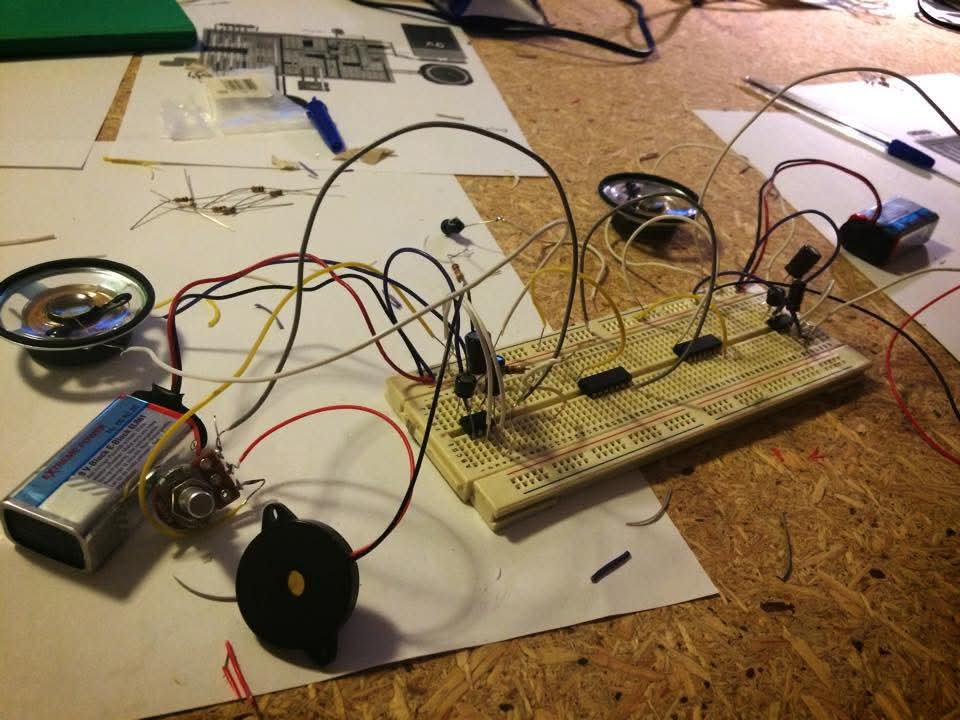
Even back then, I was often more interested in sounds than in the music itself: monotonous hums, squeaks, and buzzes. I could listen intently to a seemingly unchanging tone for a long time, waiting for the slightest fluctuation in timbre, pitch, or vibration. After finishing music school, I stopped playing the piano. The urge to play, however, did not disappear. For a long time, it was simply muted. It resurfaced in 2015. That was when I took part in a workshop at the Centre for Contemporary Art in Warsaw led by Juan Duarte, a resident of the European program “Sound of Culture – Culture of Sound” (SoC–CoS). We built simple portable electronic devices – light-responsive generators and transducers that allowed us to listen to the city’s electromagnetic environment. For the first time in my life, I assembled a simple light-responsive electronic instrument on my own.
I don't remember whether it was a particularly good sound generator. What I do remember, though, is the moment I started turning the potentiometer more and more slowly – every slight change was audible, but the sound didn’t behave exactly the way I wanted it to. Instead of striving for a single “correct” result, I had to listen to what the circuit was doing and react to what was happening.
At that same workshop, I met Mateusz Śmigasiewicz, with whom I later formed the improvisational duo Euphonia Pseudolarix. A year later, I stumbled upon MusicMakers Hacklab during the CTM Festival. More circuits emerged, along with soldering, homemade devices, mistakes, and sounds that behaved a little differently than the schematic predicted. I also began to understand something fundamental: what actually happens between the movement of my hand and what I hear. The potentiometer was no longer just a “tone” knob – its movement caused a specific change in the circuit, which translated into sound. I didn’t go on to become a master of the soldering iron. Some of the devices I built back then are long gone, and I didn’t pursue instrument building anymore. What has stayed with me, however, is a certain way of listening – greater attention to subtle changes, an acceptance of sound that can’t be fully controlled, and a willingness to follow it.
It was not Pauline Oliveros, but those very buzzers that taught me how to listen attentively. Perhaps that’s why, in DIY projects, I'm most interested not in the handmade object itself, but in what you can learn while building it.
Back then in Warsaw, I wasn’t the only one who was into such objects and practices. I met more and more people who were buying sets of resistors, potentiometers, and the cheapest components at electronics markets. In the spirit of peer-to-peer sharing, we emailed each other Nicolas Collins’s Hardware Hacking – a makeshift PDF with hand-drawn schematics and “recipes.” It served as the prototype for his subsequent Handmade Electronic Music. The Art of Hardware Hacking (Routledge, 2006). In our circle, it was one of the first, and for a time, practically the only, accessible guide to DIY audio electronics.
Collins didn’t offer any engineering course or systematic introduction to electronics. On the contrary: minimal theory, inexpensive parts, a few simple circuits, and a quick transition to hands-on work. Contact microphones glued to everyday objects, coils picking up electromagnetic fields from the surroundings, modified toys, simple generators responding to light, touch, or the movement of a potentiometer. The prototype was meant to “start buzzing” as quickly as possible and let you hear for yourself what changes the pitch, timbre, or volume of a sound – and how even a minor intervention in the circuit affects what you hear. There was no single “correct” way to do it. Simple circuits were forgiving of mistakes.
The textbook's history suits the way it later functioned. Collins prepared the first materials in the early 2000s for students who – as he later recalled – complained about the “lack of immediacy and tactility in digital media.” He wanted to combine the electronic world of sound with the gesture of the hand. From these notes emerged a makeshift textbook in PDF format that, as he wrote, “somehow escaped the walls of the school.” It made its way outside the university, led to subsequent workshops, and only later evolved into a book.
Knowledge itself spread similarly. It moved between workshops, concerts, studios, friends, and successive artistic projects. Some people built their own generators, others took apart found devices or used either feedback loops or contact microphones. It wasn’t a single “school” or a cohesive scene, but rather a loose network of people connected by shared interest in sound, technology, and the possibility of using it in ways that were not entirely intended by the makers.
One such person was Radosław Sirko. We’ve known each other for years – we were brought together not only by experimental music and our approach to technology, but also by the political and ethical meanings we attributed to DIY back then. Over time, Sirko transferred some of the practices he had developed within this informal circle to a much more structured environment – the Academy of Fine Arts in Warsaw.
Making something in order to understand it
At the Faculty of Media Arts at the Academy of Fine Arts in Warsaw, Radek Sirko (also known as experimental electronic music artist Duy Gebord) teaches a course entitled “Sound in Audiovisual Works.” He operates within his own “studio” (pracownia, a key academic entity) and gradually develops it. Students from various backgrounds and majors enrol in his class, often without any musical or technical background. “They come in and say, ‘I don’t know anything,’” he explains. So they start with the basics: recording, operating a mixing console and effects, as well as simple electronic circuits. Some topics, in fact, don’t come up until the class is in session. Sirko recalls a situation where, instead of proposing the next exercise, he simply asked the students, “What do you want to learn?” They wanted to know what the green circuit boards, wires, and electronic components they’d seen in the lab were.
One of the first experiments of the course involves the piezo – a cheap piezoelectric transducer that can be attached to anywhere. “I show them that you can amplify the sound of anything,” says Sirko. A sheet of metal, a piece of wood, a ceramic vessel, or a box can act as a sound source or carrier. This same simple component allows you to capture the subtle vibrations of an object. It can also transmit these in the opposite direction and make the material resonate. At this point, the question of what constitutes an instrument gets complicated: there’s no longer any need to buy a ready-made object designed specifically for playing music, as sound can be extracted from things that previously had no place in the world of music.
The next step involves the simplest DIY electronics kits. A few dozen zlotys, two hours of soldering, and you end up with a finished generator featuring a few potentiometers. But such a kit is, above all, a puzzle – waiting to be assembled according to the instructions. So Sirko takes it a step further: a breadboard, a few components, sometimes an Arduino. A light-sensitive photoresistor can control a speaker, but the latter can be replaced with an LED or a small motor. Instead of a photoresistor, you can use a temperature sensor. It’s no longer just about assembling a single device, but about understanding the relationships between input, processing, and output.
From such simple exercises, emerge artwork-devices that cannot easily be classified as art instruments. One student built an object with a servomotor hidden inside. The mechanism merely moved and scraped; to hear it working, you had to put your ear to it. “There’s no speaker and no melody, just a shuffling sound. And that’s already interesting,” says Sirko. On another occasion, a student worked with a plant and a circuit that detected changes in an electrical signal. Instead of translating them into a pleasant melody or harmony, she left the raw, fluctuating buzz as it was. “Electricity. Searching for a way to convert electricity into sound,” Sirko sums up. Students often don’t come to the studio just for the sound itself. They don’t have strictly musical or production-related intentions. They work in the visual arts and want to use sound in an installation, performance, or object. Not all of these devices survive until the end of the semester. Some students solder the circuit, test it, and then set it aside on a shelf. Sirko takes apart these unfinished projects, recovering the sockets, wires, and piezo elements to use in his next project.
DIY at ASP1
Sirko’s pracownia is one of the places through which sound practices are making their way into Polish academies of fine arts (ASP) today. Art education remains strongly divided along institutional lines: academies of fine arts almost always operate separately from music academies and universities. Sound art, experimental electronics, and DIY built instruments fall somewhere in between. At one place, sound emerges through instruments and composition; at another, it might begin with a piece of sheet metal, a motion sensor, or an object that suddenly starts to make sounds.
At fine arts academies, sound hasn’t been assigned a single, distinctive, clearly “dedicated” place, anyway. In Warsaw, it falls under the Faculty of Media Art; in Kraków and Poznań – Intermedia; and in Łódź – Photography and Multimedia. The very proximity of these fields speaks volumes. Sound functions alongside image, performance, sculpture, installation, interaction, and new media – rather than as a separate language that must first be mastered. That is why the question of whether something is “already” or “still” an instrument quickly becomes irrelevant.
At Marek Chołoniewski’s Pracownia Audiosfery (Audiosphere Studio) at the Academy of Fine Arts in Kraków, the construction of new instruments is a part of a program that also includes acoustics, electroacoustic music, performance, resonance, and interactive systems. In Sirko’s program, the fundamentals of electrical engineering are explored alongside sound art, acoustic ecology, sound synthesis, and audiovisual objects. At Aleksandra Chciuk’s Pracownia Audiosfery in Łódź, listening and field-recording exercises lead to students’ own sound projects, in which everyday objects or architectural elements can become instruments. These different programs, however, converge at a similar point:sound does not have to result in a composition; it can become one element of a larger work.
This may seem a minor difference, but it is of great significance for DIY practices. A student of sculpture or intermedia does not necessarily need an “instrument.” Sometimes they simply need a specific element of their work to react, move, or make a sound. There’s usually no ready-made device for this. So you have to find a sensor, choose a mechanism, test the material, and connect a few things that weren’t necessarily designed to work together. And so, someone who came to art school with a paintbrush, a chisel, or a camera may, after a few weeks, find themselves holding a breadboard and a soldering iron. Not because they’ve changed their focus. Electronics simply turn out to be the solution to problems off-the-shelf tools can’t solve.
In Kraków, perspective gets more complicated. Marek Chołoniewski, active there for decades, operates on both sides of the institutional divide. He is a composer and educator affiliated with the Studio of Electroacoustic Music at the Academy of Music and at the same time he leads the Pracownia Audiosfery at the Faculty of Intermedia at the Academy of Fine Arts (as an assistant to Piotr Madej). The program at Kraków’s Audiosphere begins on a fairly musical note – with the history of contemporary music, compositional techniques, and improvisation. Later, the focus shifts to acoustics, resonance, electronics, performance, new instrument construction, and interactive systems. At a later stage, the instrument itself may take a back seat. What it triggers becomes more important: the performer’s movement can alter the sound, the sound can influence the image, and the electronics can react to what is happening in the space. Sometimes, therefore, it is necessary to build a new instrument, and sometimes an entire system of interdependencies that functions only within a specific work is needed.
For Chołoniewski, this way of thinking doesn’t stop at the threshold of the Academy of Fine Arts. The same tools and similar working methods come together at the Kraków Studio of Electroacoustic Music. During the studio’s concert in 2026, alongside the violin and voice, there were modular synthesisers, laptops, a gamepad, objects, live visuals, and electronics processing sound in real time. It’s hard to tell from this alone in which institution we happen to be in. On paper, the division remains clear. In practice, this division quickly ceases to be tangible.
In Łódź, the instrument loses its usual shape even further. At Aleksandra Chciuk’s Audiosphere Studio, students create “pieces for a teapot, rattle, and drops of water”: compositions that make use of household appliances, field recordings, and imaginary scores. But before an object can begin to play, one must first learn to listen to it. The studio’s program begins with exercises in deep listening, field recording, and exploring the physical properties of sound. Only later does the process of building one’s own instruments begin. A contact microphone serves as a good guide to this way of thinking. When attached to a windowpane or a pipe, it brings to light vibrations that are easily overlooked in ordinary listening. Suddenly, there’s no need to build an instrument from scratch. You can find one in a radiator, a piece of fabric, a factory machine, or a piece of architecture – provided you can figure out how to activate it and hear it.
The pracownia also became a springboard for the experimental Kolektyw Pełnia („Fullness Collective”).2 Its arsenal of instruments included medical machines, construction tools, parts from old factories, everyday objects, as well as an accordion or a prepared piano. While working on a composition called Sieci in Sokołowsko, a deep well became one of the instruments. Its pipe modulated the voice, its surface transmitted footsteps, and the microphones’ placement was dictated by the very architecture of the site. Constructing the instrument here involved less of a building of a new object and more finding a way to utilise the acoustic properties of what was already there.
The Poznań’s Audiosphere at the Magdalena Abakanowicz University of Arts (UAP) on the other hand was founded in the late 1990s by Leszek Knaflewski – a painter by training, as well as musician and creator of object-instruments by passion. Over the following years, the pracownia welcomed, among others, Konrad Smoleński, Wojciech Bąkowski, Piotr Bosacki, and Daniel Koniusz. For some of them, sound later became one of the primary materials of their work. Nevertheless, it would be difficult to reduce their practice strictly to sound art. In Smoleński’s pieces, a sound system can function simultaneously as a sculpture and a source of an almost physical experience of sound; in Bąkowski’s work, recording, voice, image, and text are merged from the very beginning. Moreover, in 2004, the KOT Group was formed there, with Bąkowski, Smoleński, Knaflewski, and Bosacki as its members. Cassette recorders became instruments, and the academic studio – a place where people began to play and collaborate. These same people later came together in the Penerstwo art group and around the so-called PinkPunk scene. After Knaflewski’s death, pracownia did not disappear. For quite a few years it has been run by Daniel Koniusz, resembling rather an open platform than a traditional studio within the academy,with its own (albeit ephemeral) label, the Audiosfera Studio Recordings Series (ASRS), and the O.S.A. series, intended for participation of people active outside UAP. The tools and the way things are organised have changed, but a certain continuity remains. What began at a single table in a classroom later continued outside the university.
Travelling further North-West, we arrive in Szczecin, where DIY culture has been integrated into the studio’s very curriculum of the joint Academy of Arts, which encompasses both music and fine arts. Łukasz Jastrubczak and Zorka Wollny, at the Interdisciplinary Activities Studio, place it alongside Fluxus, Black Mountain College, and Artist-Run Spaces. Students form duos and larger groups write manifestos and organise their own events. Thus, their work is more process-oriented, as the essence of the work is no longer limited to what will ultimately be exhibited. One must also consider the conditions under which the work can come into being at all – the people, the place, and the format of the event.
This is quite a significant shift in scale. In Poznań, various groups emerged from the pracownia, each with their own ways of presenting their work. In Szczecin, the very act of organising an event is woven into artistic practice. This same mindset gave rise to Młode Wilki, a festival held by the Academy of Art since 2014 and co-created by Jastrubczak3. The open call targets students from art colleges across Poland. Coming to Szczecin isn’t just about showing finished work. Concerts, presentations, discussions, and the gathering itself matter just as much. From the very beginning, the festival has thus functioned more as a space for exchange than as a competition for finished works. The festival's first edition was especially dedicated to sound art, and the 2025 edition, organised within the framework of tekhnē, returned to those roots.
This approach also extends beyond the academy. Jastrubczak and Wollny organised the Duos Festival, based on collaboration between artists from Poland and Kenya. Jastrubczak also co-runs CentrumCentrum – an artistic space operating within the city’s community gardens. At a certain point, it becomes difficult to distinguish between academic exercises and collaborative work, organising events, or running one’s own space. Here, DIY starts to be less about working with one’s hands on a specific object. “Do it yourself” becomes: “create the conditions for your own activity.”
Ten spots for students, five for people from outside the university. This was the breakdown during “Magisterelektronika,” a four-day workshop held jointly by the Academy of Fine Arts and Biuro Dźwięku Katowice. At the same tables, participants soldered, read schematics, experimented with circuit bending, and built simple electroacoustic instruments. The Academy and the local scene came together here quite literally. People move between them in a similar way. Jan Dybała graduated from the Academy of Fine Arts in Katowice, later returned as a lecturer, and for nearly a decade served as a curator and educator at Biuro Dźwięku Katowice. Piotr Ceglarek is a co-founder of Biuro Dźwięku Katowice and also teaches at the academy. They work within Soundscape Foundation that co-operates with the Academy regarding a large, state-of-the-art electronic instrument called Tonarium. Sometimes they cross paths in the curriculum, and other times at concerts, workshops, or micro-residencies.
Biuro Dźwięku is both an institution and a sound system, DIY acousmonium inspired by futurists' intonarumori. Sometimes, the infrastructure moves along with the people. When the Biuro Dźwięku couldn’t use its headquarters, the finale of one of the micro-residencies took place at the Academy of Fine Arts’ laboratory. For a moment, the university space became the venue for an initiative operating outside the academy.
Katowice thus complicates the simple narrative in which knowledge is first generated at the university and only later enters the scene. The flow is two-way – experiences gained outside the academy find their way into the classroom, and the university’s resources serve projects emerging elsewhere. The Academy of Fine Arts is one of the hubs of this movement – not necessarily its beginning or its end.
From here a paradox rises. In the context described, DIY relied on cheap components, borrowed tools, instructions shared among friends, and knowledge acquired bit by bit. Meanwhile, years later, some of these practices found their way into the curriculum, received a classroom, a budget, an instructor, and ECTS credits.
Collins’ story thus comes full circle in a rather peculiar way. His makeshift PDF once “escaped” school and began a life of its own outside of it. It circulated among people, finding its way into workshops, home studios, and informal communities. Today, a similar approach to learning is returning to the university – now as part of the curriculum. Those who taught themselves electronics in workshops and learned from one another eventually became lecturers, workshop leaders, or organisers. The old instinct to take devices apart and bypass ready-made solutions themselves hasn’t disappeared. It’s simply become a full-time job.
Does DIY cease to be DIY when it becomes an academic subject? It would be easy to conclude that this grassroots practice has simply been co-opted by the institution. Except today, it’s precisely the university that can give someone a few semesters to try things out, mess things up, and start over – a luxury that’s hard to overestimate, especially when an experiment doesn’t have to immediately result in a concert, a product, or income. For some students, the workshop is also one of the few places where they can simply take something apart, solder, repair, and test it with their own hands. In a world of increasingly closed-off devices and ready-made interfaces, academia paradoxically restores this very basic experience of tinkering.
A more interesting question seems to be what remains of DIY once it enters the institution. The practice still retains a distrust of ready-made tools, promotes a need to look inside things, and offers the freedom to combine elements that were not originally intended to work together. The lack of a suitable tool, format, or space doesn’t have to put an end to an idea – it can create the space to experiment on your own. In this narrative, the art academy becomes one of the places through which DIY passes: it enters the university with experiences gained elsewhere, makes use of its resources, and then goes back out into the world – already in a slightly altered form.
In each of the cases discussed in previous paragraphs , DIY practices appeared at the Academy after years of experiments in “ students’ galleries”, that hosted experimental sounds since the 70s, such as Galeria Akumulatory2 (run by Jarosław Kozłowski) in Poznań, Pracownia Dziekanka & Riviera Remont in Warsaw (run by people such as Piotr Rypson, Tomasz Sikorski, Andrzej Mitan). In Łódź and Katowice, crucial audiovisual experiments were conducted at the Film School (Łódź, especially Workshop of the Film Form, WFF) and the Television School (Katowice, especially the LTP group). In Kraków – the most important were the ties to the Kraków Studio of Electroacoustic Music.
Distorted harmony
At music academies, DIY is being introduced using different routes. In 2026, applicants for the composition program at the Academy of Music in Łódź are required to submit at least three original scores – including one for a larger ensemble – and pass exams in music theory, harmony, and sight-reading. For Warsaw’s graduate program for music creators, knowledge of traditional notation and three original scores are still required. Before a student picks up a soldering iron, a microcontroller, or their own interface, they enter a world where everything already has its place – the instrument, the score, the performer, the composer.
This is a significant difference from the Academies of Fine Arts. In intermedia, electronics might appear as part of working with an object. A composer usually starts elsewhere – with existing instruments, performance techniques, and methods of notation. The piano has its own keyboard and repertoire; the violin, a technique refined over generations; and the electroacoustic studio, a whole set of tools for sound synthesis and processing.
Electronics is, of course, by no means a newcomer to music academies. The Kraków Studio of Electroacoustic Music was founded in 1973 on the initiative of Józef Patkowski as Poland’s first educational studio for electronic music. A year later, a two-year course was launched there for students of composition, conducting, and music theory, and the initial equipment consisted primarily of analogue EMS systems. Włodzimierz Kotoński founded the Warsaw studio, now operating as the Chopin University Electronic Music Studio, in 1990. The electronic studio has thus long been part of a composer’s academic toolkit.
However, the presence of electronics does not yet equate to DIY. The studio provides access to a ready-made set of tools. Do-it-yourself construction usually begins when that set is no longer sufficient. A composer or performer may need a sensor that responds to a specific gesture, an unusual controller, a mechanism that triggers an instrument, or a system in which electronics respond directly to body movement rather than to the pressing of a key or a mouse click.
Sometimes a suitable solution exists, but it’s designed for a professional studio and simply doesn’t fit a single premiere's budget. And it rarely grows in tandem with the composer’s technological ambitions. In such cases, it’s easier to use an Arduino, an inexpensive sensor, or a small motor; 3D-print the missing component; write a piece of code; or modify a device already on hand.
The relationship with technology also changes at that point. Instead of choosing from the functions provided by the manufacturer, the composer begins to adapt the tool to his own vision. DIY becomes both a way to expand the instrument’s capabilities and a quite pragmatic method of bringing a piece to the stage. It does not replace academic electronics, but emerges where a ready-made studio and available instruments are no longer sufficient.
Krzysztof Cybulski is one of the composers and instrumentalists that has followed this path. He is a composer and musician by training, but he has devoted a significant part of his practice to constructing instruments that simply did not exist before. In 2024, he defended his doctoral dissertation at the Warsaw University of Music, based not on a single composition but on three acoustic-digital instruments he built himself and the improvisations performed using them. Here, the instrument ceases to await the composer before work begins, it is created alongside the music it is meant to serve.
Such a tendency is already clearly evident in his earlier Acoustic Additive Synth. From a distance, it resembles a small pipe organ, but the pitch and airflow are controlled electronically. A computer analyses the signal and sets the instrument’s mechanical components in motion, and in the end, a physical, acoustic sound is still produced. Cybulski, therefore, isn’t simply building his own version of a synthesiser. The digital method of organising sound brings it back into the world of mechanics and air. The instrument can smoothly change pitch and go beyond the twelve-tone tuning – its capabilities stem directly from how it was constructed.
In subsequent projects, Cybulski began designing not only the instrument’s sound but also its behaviour. In Modular Process Music, the devices “listen” to one another via microphones and speakers and react to incoming sounds. They are not connected by cables like synthesiser modules – they respond to one another acoustically, much like musicians during an improvisation. Cybulski calls this method “process music.” Instead of determining a fixed sequence for a piece, he designs the conditions under which the music can emerge. Some decisions are made by the performer, some occur during the concert, but others were programmed long beforehand – including what the device will listen to, what it will react to, and what responses its designer has enabled it to produce. The composition thus begins even before the first sound is heard, during the design of the machine itself.
Cybulski developed this approach in his doctoral project, AAAA: a set of three acoustic-digital instruments – the Post-Digital Sax, the autoviola, and the aeromembranophone – on which he performed ensemble improvisations alongside Piotr Zalewski and Hubert Zemler. The Post-Digital Sax retains the physical reed and bell of a saxophone, but its pitch can be controlled digitally. Thus, the electronics do not replace the instrument but rather intervene in how it functions. In such a model, it becomes increasingly difficult to pinpoint the moment when building ends and composing begins. By designing the instrument, Cybulski immediately establishes some of the rules for the future music. What in a traditional piece might be found in the score is here often encoded in the mechanism, the program, or the way the device responds to the performer.
Wojciech Błażejczyk, who currently heads the Chopin University Electronic Music Studio, works at the same university. His own instruments, however, are made from far less academic materials: a lampshade, a range hood, a serving platter, a clock spring, or a broken clothes dryer. Equipped with contact microphones and set into vibration, these objects become “objectophones.” Another of his instruments is the “gestophone,” which translates body movement directly into sound parameters..
Mateusz Śmigasiewicz also works in the department; I met him in 2015 at the same workshop at the Center for Contemporary Art where my own journey into DIY began. A dozen or so years later, he teaches composition at the Fryderyk Chopin University of Music, leads classes on contemporary compositional techniques, and works with students interested in electronic and computer music. This does not mean, of course, that younger composers have suddenly started soldering their own instruments. Rather, the environment in which music is created has changed. In the “Composition with Electronic, Film, and Theatre Music” specialisation, computer technologies and live electronics are now part of the everyday toolkit, and master’s degree applicants present works that utilise electronic media alongside pieces without electronics. The soldering iron has not replaced the score – it has simply found a place alongside it. However, as the tools available change, so too does the relationship between the musician and the instrument.
You don’t improve the piano; you improve the pianist. A large part of education in instrumental departments is based precisely on this premise: the instrument is “complete,” and over the years, the performer learns to make better and better use of its capabilities and to overcome their own limitations.
With a DIY instrument, this order can be reversed. If the instrument doesn’t do what the musician needs it to, the instrument itself can be modified. It also doesn’t have to be versatile or perfect. It can be small in scale, have a delayed response, limited “processing power,” or allow only a few very specific gestures. From the perspective of classical instruments, these would be limitations. Here, they may be precisely the reason the instrument was created.
At the opening concert of the Warsaw Autumn festival in 2023, however, Cybulski did not play alone. He played the Post-Digital Sax, Piotr Zalewski played the autoviola, and Hubert Zemler played the aeromembranophone. One man built all three instruments, but he entrusted two of them to other musicians. And this is where another difference from instruments with an established performance tradition emerges. A new instrument does not yet have its own technique. It must first be developed – needs figuring out which gestures work, what can be controlled, and where the device begins to act on its own. The performer thus becomes, in a sense, its first tester. The real problem actually begins even later. A score can sit on a shelf and be read again years later. In the case of an instrument built for the purposes of a specific piece of music, one must also preserve the object itself and the knowledge of how it works. If one of its components stops functioning, or no one is left to repair it, performing the piece again may prove harder than simply reading the score.
DIY thus gives the composer the opportunity to create a tool tailored precisely to their own music, but along with this freedom comes a new kind of responsibility. The instrument must not only be built, but others must also be taught how to use it – and a way must be found to ensure that the knowledge is preserved along with the instrument itself.
(in)dependent
Up to this point, DIY could still be understood quite literally – as tinkering with a tool or building one from scratch. Beyond this point, that definition is no longer sufficient. The focus shifts from the tool itself to the conditions under which it can be used. The resources needed for the work and the way they are organised are becoming increasingly important.
A cheap setup or a free manual does not yet mean self-sufficiency. A handmade instrument may be created using resources that a single person does not possess on their own. DIY can lower the cost of a tool, but it shifts part of that cost to the time needed for learning and failed attempts, as well as access to a space where such work can take place.
The answer has always been the community and cooperation. It’s not a coincidence that the main characters of this story work and collaborate with various institutions – Sirko has graduated from the University of Arts in Poznań, and also taught in Katowice; Cybulski teaches at the Music Academy in Bydgoszcz, but had an exhibition at the Faculty of New Media of the Academy of Fine Arts in Warsaw.
Outside of academia, there’s also the need to organise the infrastructure and space where the work can take place. This is where the line between what is independent and what is institutional begins to blur. Both Sirko and Cybulski conducted DIY electronics workshops at various music festivals (i. e., Unsound, Futurofonia, Control Room) and with various local cultural institutions. Quite a few important independent venues as well as labels (i. e., Pointless Geometry, Pawlacz Perski, Wounded Knife, Antenna Non Grata) and community radios (Radio Kapitał, Radio Klang, Radio Ingrid) were also crucial to the development of a diverse tinkering community.
For seven years, the Eufemia Club operated in the basement of the Academy of Fine Arts in Warsaw. People could come there with an idea for a concert or event and try to make it happen. Thanks to the program’s openness, the place quickly evolved from a student hangout into one of the crucial hubs of Warsaw’s independent scene. In 2017, however, the Academy terminated the tenant’s lease. A petition signed by about 2,000 people didn't help. A year later, part of the Eufemia team opened Młodsza Siostra in the Powiśle district. The name itself suggested continuity – they tried to preserve the previous combination of concerts, food service, and a meeting place, but outside the walls of the Academy. In Poznań, a similar role was taken by a small art space, Kołorking Muzyczny, operated under the auspices of the Music Academy and the guidance of composer Rafał Zapała, who prematurely passed away last year. However, the initiative – devoted to all kinds of musical experiments – still exists.
In Wolimierz, Lower Silesia, the facilities were built differently – from the very beginning as an integral part of the project itself. In 2016, Atelier provided participants with the open-air workshop with studios for electronics, welding, wood- and metalworking. People could arrive with an idea, use the materials, learn something from others, or collaborate on a project. A year later, the Borderline Noise Festival kicked off, attracting creators of experimental electronic music, noise, and sound art to Wolimierz for seven editions; the last took place in 2024. Here, the practice of making things by hand gradually expanded to include building the entire technical infrastructure for the work. DIY was no longer limited to what was created on the workbench – it also encompassed the conditions that made it possible to create and showcase anything at all.
Polish independent music has been on the move for a long time. Addresses, names, and formats change, but it’s rare for any subsequent initiative to start from scratch. People bring along their contacts, equipment, knowledge, and ideas. What no longer fits in one place eventually takes root elsewhere – as a label, festival, radio station, or another venue. Frequently, various artists travel abroad for extended periods, but often they eventually come back and develop new initiatives or institutions. It’s easy to call this cycle a “scene,” though in practice it seems more like several overlapping circles. People meet at concerts, release each other’s music, lend each other equipment, and later lead workshops or open new venues. Sometimes this gives rise to a collective; sometimes, nothing lasting emerges. They aren’t united by a single aesthetic or a shared program – noise, improvisation, experimental electronics, or sound art can coexist without needing to form a single whole.
The further one moves away from the instrument itself, the less obvious the “self” in “do it yourself” becomes. Behind a buzzing setup lies someone else’s blueprint and knowledge passed down; you can renovate a club with your own hands, but you’re still operating in someone else's building. Self-reliance, therefore, is always partial. DIY may increase control over one’s work, but it does not eliminate the dependencies that make that work possible.
***
When I built my first simple generator in 2015, I was mainly interested in what I would hear when I turned the potentiometer. Over time, the experience of tinkering with a finished device became increasingly important – the ability to take it apart and see what actually produces the effect. This gesture recurs in many of the practices described here. Sometimes it concerns the instrument, sometimes the way it works, and sometimes the conditions under which that work can take place. It does not provide complete independence and usually requires infrastructure created in collaboration with others. In return, it offers the opportunity to verify whether a ready-made solution is truly the only one possible.
Bio:
Izabela Smelczyńska (PL) is a Warsaw-based sound artist, musicologist, and writer working across experimental music, sound art, and sound studies. Her practice explores listening as both an artistic and research method, with a particular interest in acoustic ecology, sound education, and DIY approaches to sound-making.
This essay was translated from Polish by Antoni Michnik.
-
In Poland ASP is a common acronym used referring to various Fine Arts Academies, Schools of Arts or University of Fine Arts. ↩
-
One of the members of the now defunct collective was Joanna Dreczka, who has taken part in Młode Wilki festival in Szczecin, that took place within the framework of tekhnē project activities (see the multi-interview by Weronika Bielecka in this issue). ↩
-
The literary translation of the festival’s name is Young Wolves, as the reference to the film from 1995 directed by Jaroslaw Żamojda, athough the meaning is more likely Young Guns. ↩